


Real estate flipping is a strategy that involves acquiring a property with improvement potential, renovating it and subsequently selling it with the aim of generating a profit. The result depends on the difference between the sale price and the total cost of the transaction, including the acquisition, taxes, renovation, financing and marketing expenses.
Also known as house flipping or property flipping, this strategy requires active management throughout the project. Its profitability does not depend solely on market performance, but also on the accurate identification, transformation and marketing of the property.
In this article, we examine how to identify a real estate flipping opportunity, the different stages involved in the process, how profitability is calculated and the risks that should be assessed before investing in this type of strategy.
What does real estate flipping actually involve?
Real estate flipping is not simply about buying a low-priced property and waiting for its value to increase. The transaction must be based on a specific value-creation opportunity, such as an inefficient layout, poor condition, outdated installations or an inadequate marketing approach that prevents the property from competing with other renovated assets in the area.
The objective is to address these limitations and create a product that responds more effectively to market demand. Before acquiring the property, it is therefore necessary to determine:
Flipping is a specific form of value-add real estate investing, as it seeks to generate value through active intervention in the property.
However, not every value-add transaction is a flipping project. A value-add strategy may also involve renovating a property for rental purposes, changing its use, improving its management or retaining it in the portfolio after repositioning it.
From acquisition to sale: the stages of real estate flipping
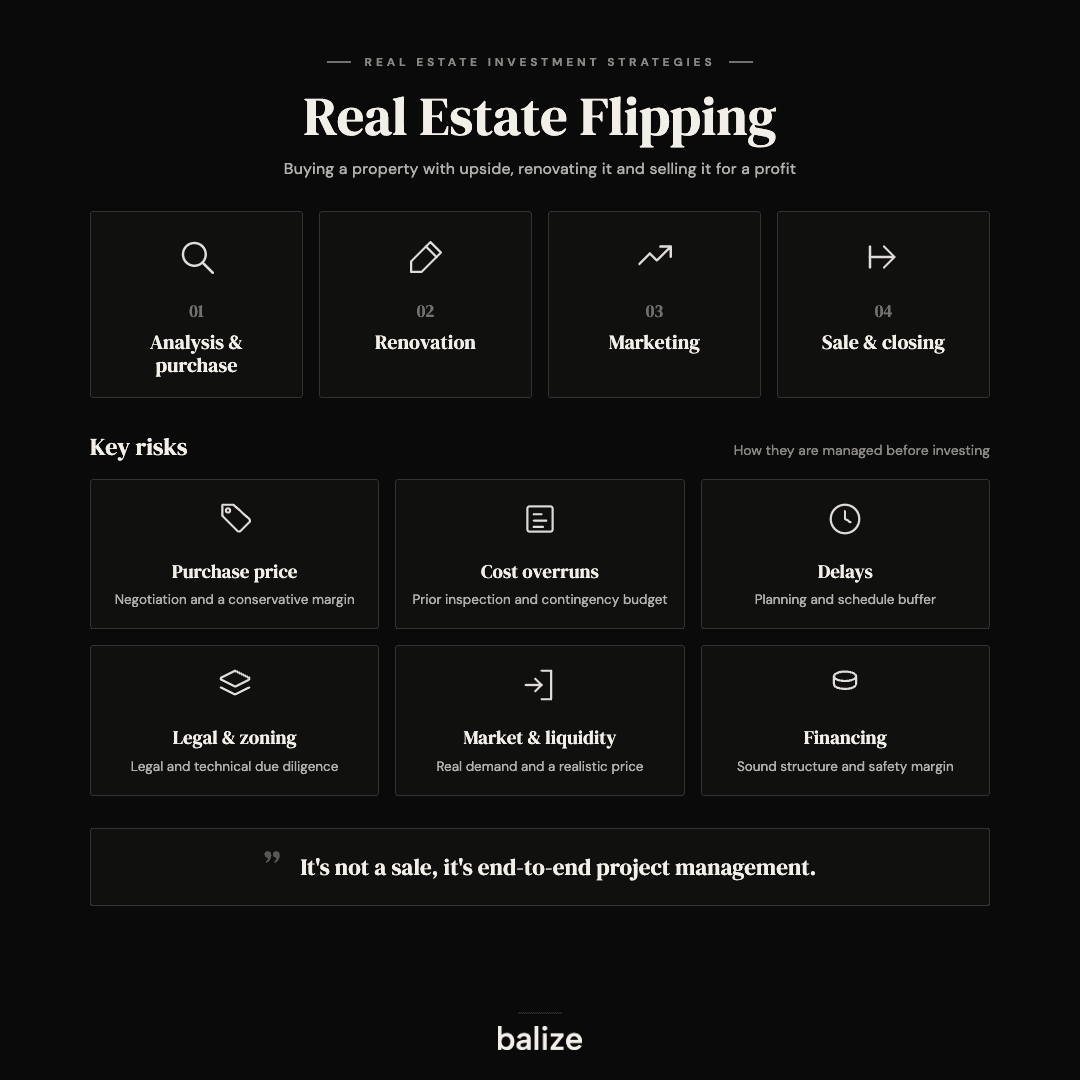
In general terms, a real estate flipping transaction is structured around four main stages: analysis and acquisition, renovation, marketing and sale.
1. Property analysis and acquisition
The first stage consists of identifying an asset with improvement potential and confirming that the transaction is viable from a commercial, technical, legal and financial perspective.
Before completing the acquisition, it is necessary to analyse local demand and prices, the condition of the property, the required renovation, the expected timeline and the sale price the finished product may be able to achieve.
The total transaction cost, or all-in cost, must also be calculated. This may be grouped into the following categories:
The final product should be defined from this initial stage, including its layout, specifications, target buyer and price range. For a more detailed explanation, see our guide on how to analyse a value-add real estate project.
2. Renovation and value creation
Once the property has been acquired, the transformation process begins. The renovation should respond to the needs of the target buyer and focus on improvements that the market is likely to recognise in the final sale price.
During this stage, it is essential to control the scope of work, budget, schedule, licences and coordination of the professionals involved.
The renovation may improve the layout, modernise installations, increase the functionality of the space or adapt the specifications to the intended market positioning. However, using more expensive finishes does not guarantee higher profitability if buyers are not willing to pay for them.
A renovation creates economic value when the improvement achieved exceeds the cost required to deliver it.
3. Marketing the property
The marketing strategy should be defined before the renovation is completed. Pricing, presentation and sales channels must be aligned with current demand and the comparable properties available at that time.
Photography, home staging, documentation and the management of viewings can influence both the marketing period and the offers received.
4. Sale and completion of the transaction
The final stage includes negotiating and completing the sale, settling any outstanding expenses and calculating the final result of the transaction.
Until the sale is completed, profitability remains exposed to potential changes in costs, timelines and the exit price.
How long can a real estate flipping transaction take?
There is no fixed timeframe that applies to every project. The duration depends on the condition of the asset, the scope of the renovation, the licences required, the availability of the professionals involved and the time needed to find a buyer.
As a general indication, a flipping transaction may take approximately between 6 and 18 months. This range should not be interpreted as a guaranteed timeframe, as each project must establish its own schedule and account for potential delays.
A longer timeframe may increase financing, holding and marketing costs, while also keeping the invested capital committed for a longer period.
How is the profitability of a flipping transaction calculated?
Profitability cannot be determined by comparing only the purchase price and the sale price. To calculate the actual result, it is necessary to deduct all costs required to acquire, transform, hold and sell the property.
In simplified terms, the result may be calculated using the following formula:
Transaction result = sale price − total transaction cost
The return on investment can then be calculated as follows:
Transaction ROI = net transaction profit ÷ total transaction cost × 100
For example, if the total cost of a transaction is €300,000 and, after deducting all expenses, it generates a profit of €30,000 before tax, the total ROI of the transaction would be 10%.
Source: hypothetical example prepared for information purposes only. It does not relate to an actual transaction, a balize forecast or an expected return.
You can explore these differences in greater detail in our guide on how to calculate the return on a real estate investment.
Real estate flipping compared with other investment strategies
The defining feature of flipping is that the sale of the property forms part of the strategy from the outset. This distinguishes it from other approaches based on holding or operating the asset over a longer period.
Primary objective |
Source of return / typical exit |
|
Real estate flipping |
Buy, transform and sell. |
Margin generated on the sale / Sale of the renovated property |
Buy and hold |
Buy and retain. |
Rental income and potential capital appreciation / Long-term holding or sale. |
Renovate to rent |
Buy, renovate and operate the property as a rental asset. |
Rental income and potential capital appreciation / Long-term holding or subsequent sale. |
For information on other alternatives, see our article on real estate investment strategies.
Main risks associated with real estate flipping
Like any investment, real estate flipping involves risks. The purpose of the initial analysis is not to eliminate them entirely, but to identify them, estimate their potential impact and assess whether the expected return adequately compensates for the uncertainty assumed.
Potential impact |
Risk mitigation measures |
|
Purchase price |
Reduces the available margin from the outset. |
Comparable analysis, negotiation and conservative scenarios. |
Technical risk and cost overruns |
Defects or works that were not initially anticipated may arise. |
Prior inspection, detailed budget and contingency allowance. |
Legal or planning risk |
May restrict or prevent certain works or interventions. |
Legal, land registry, technical and planning review. |
Delays |
Increase financing or holding costs. |
Planning, construction monitoring and sufficient time contingency. |
Market and liquidity risk |
The sale price may be lower than expected or the marketing period may be longer. |
Demand analysis, realistic pricing and an alternative exit strategy. |
Financial risk |
Financing costs may increase or the financing may mature before the property is sold. |
An appropriate financing structure and an adequate margin of safety. |
Is it possible to invest without purchasing an entire property?
There are two main ways to participate in a flipping strategy: executing the transaction directly or investing in a project managed by a specialised team.
In a direct transaction, the investor is responsible for sourcing the asset, completing the acquisition, arranging financing, managing the renovation, controlling costs and marketing the property. In a managed project, these tasks are undertaken by the team responsible for the transaction.
Direct flipping |
Managed project |
|
Capital required |
Full purchase price and all associated costs. |
Depends on the minimum investment established for the project. |
Asset selection |
Carried out by the investor. |
Carried out by the management team. |
Renovation management |
Direct responsibility of the investor. |
Responsibility of the project manager. |
Monitoring |
Full operational control. |
Project information and reporting. |
Decision-making |
Direct control by the investor. |
Depends on the legal and contractual structure. |
Participating in a managed project does not eliminate the risks inherent in real estate flipping. Profitability still depends on the purchase price, renovation, costs, timeline and eventual sale.
Before investing, it is important to review:
How balize applies this investment strategy
At balize, each potential opportunity is analysed before it is presented to the private investors’ club.
Investors can access certain opportunities from €10,000, although the minimum investment, timeframe and target return vary depending on each project. This model makes it possible to participate in specific real estate projects without having to manage the sourcing, acquisition, renovation and sale of an entire property individually.
The role of flipping in today’s real estate market
Flipping may be particularly relevant in established locations where there is demand for renovated homes and scope to reposition outdated assets. However, favourable market conditions do not make every property a good investment opportunity.
As explained in our analysis of real estate investment in 2026, overall market performance is only the starting point. Actual viability depends on the micro-location, purchase price, total cost, execution and exit strategy.
Frequently asked questions about real estate flipping
Do real estate flipping, property flipping and house flipping mean the same thing?
Yes. All three terms are used to describe the strategy of buying, improving and selling a property. House flipping is the most commonly used English term, while real estate flipping and property flipping are broader alternatives that may also apply to assets other than houses.
How much capital is required to invest in real estate flipping?
In a direct transaction, the investor must cover the purchase price, taxes, renovation and all other expenses incurred until the property is sold. In a managed project, the capital required will depend on the minimum investment established for each opportunity.
In the balize private investors’ club, the minimum investment for this type of project is €10,000, although the specific terms of each transaction should always prevail.
Which expenses should be included when calculating profitability?
To calculate profitability correctly, it is necessary to include all costs associated with the transaction: the purchase price, taxes, notary and land registry fees, technical fees, licences, renovation costs, financing, insurance, utilities, community fees, maintenance, marketing and selling expenses.
Is the projected return of a flipping transaction guaranteed?
No. The projected return communicated for this type of project is an estimate based on the assumptions available at the time of the analysis. The final outcome may be affected by changes in acquisition or renovation costs, delays in execution, changes in financing conditions or a sale price that differs from the initial estimate.
What happens if the property is not sold within the expected timeframe?
If the sale is delayed, the transaction remains open and may continue to generate financing costs, maintenance expenses, utility bills, community fees and marketing costs. In addition, even if the final profit remained unchanged, a longer project duration would reduce the annualised return.
For this reason, the analysis should include slower-sale scenarios and an alternative exit strategy.
How does real estate flipping differ from a full refurbishment?
Real estate flipping is an investment strategy based on acquiring, transforming and selling a property, whereas a full refurbishment refers to the technical scope of the works.
A flipping transaction may require anything from a partial renovation to a full refurbishment. However, a full refurbishment may also be undertaken to rent out, operate or retain the asset over the long term.
Is real estate flipping the same as property speculation?
No. The two concepts are not equivalent. In a flipping transaction, value creation is primarily based on active intervention in the property, such as improving its layout, condition, functionality or market positioning.
However, a transaction may involve a greater speculative component when its profitability depends mainly on future price appreciation rather than on the transformation of the asset. The analysis should therefore distinguish between the value that can be generated through active management and the value that depends on broader market performance.
Conclusion
Real estate flipping can be an effective strategy for creating value through the transformation of a property, but its success does not depend solely on carrying out a high-quality renovation. Profitability is built from the initial analysis: acquiring the asset at the right price, calculating all costs, defining the final product correctly and planning a realistic exit strategy.
Flipping therefore requires more than simply buying, renovating and selling a property. It demands end-to-end project management and rigorous risk control. The quality of the analysis, execution and marketing will determine whether the identified opportunity ultimately produces a profitable result.
At balize, we analyse and manage this type of project from asset identification through to sale, applying a value-creation strategy tailored to the specific characteristics of each transaction.