


Real estate investment in 2026 is taking place in an environment of increased activity, high residential property prices and favourable expectations for real estate capital in Spain.
According to CBRE’s Real Estate Market Outlook Spain 2026, real estate investment exceeded €18.4 billion in 2025, 31% more than in the previous year, and could increase by between 5% and 10% during 2026. At the same time, the latest House Price Index published by Spain’s National Statistics Institute before the start of the year showed a year-on-year increase of 12.8% in the third quarter of 2025. New-build housing prices increased by 9.7%, while second-hand property prices rose by 13.4%.
Increased activity and rising prices may generate a greater number of transactions, but they do not automatically turn every asset into a sound investment. General market performance should be understood only as a starting point: the viability of an investment depends on the specific conditions of each project.
Identifying a genuine real estate investment opportunity in 2026 requires looking beyond general market trends and examining the specific conditions of each transaction: its location, demand, total cost, financing, risks and realistic exit options.
Key factors that will shape the real estate market in 2026
The real estate market in 2026 is expected to be shaped by sustained residential demand, insufficient supply in certain areas and uneven performance across cities, neighbourhoods and market segments.
The Bank of Spain’s Autumn 2025 Financial Stability Report had already noted that strong demand, combined with relatively inflexible supply, was placing upward pressure on prices. It also highlighted significant differences between provinces and asset types.
This uneven performance will be one of the defining features of the year. An increase in the national average does not mean that every neighbourhood, city or segment will perform in the same way. Nor does it guarantee that any property acquired in a rising market can subsequently be sold easily or at the expected price.
Therefore, to invest in real estate in 2026, it will be necessary to distinguish between three levels of analysis:
1. The overall market trend.
2. The fundamentals of the location and market segment.
3. The specific conditions of each transaction.
A favourable environment can contribute to the success of a project, but it cannot compensate for an excessive purchase price, incorrectly estimated demand or an unrealistic exit strategy. The ability to identify opportunities will therefore depend on interpreting the broader context correctly without losing sight of the specific fundamentals of each asset.
How to identify real estate investment opportunities
For real estate investment in 2026 to be based on solid criteria, investors should review six key elements before committing capital:
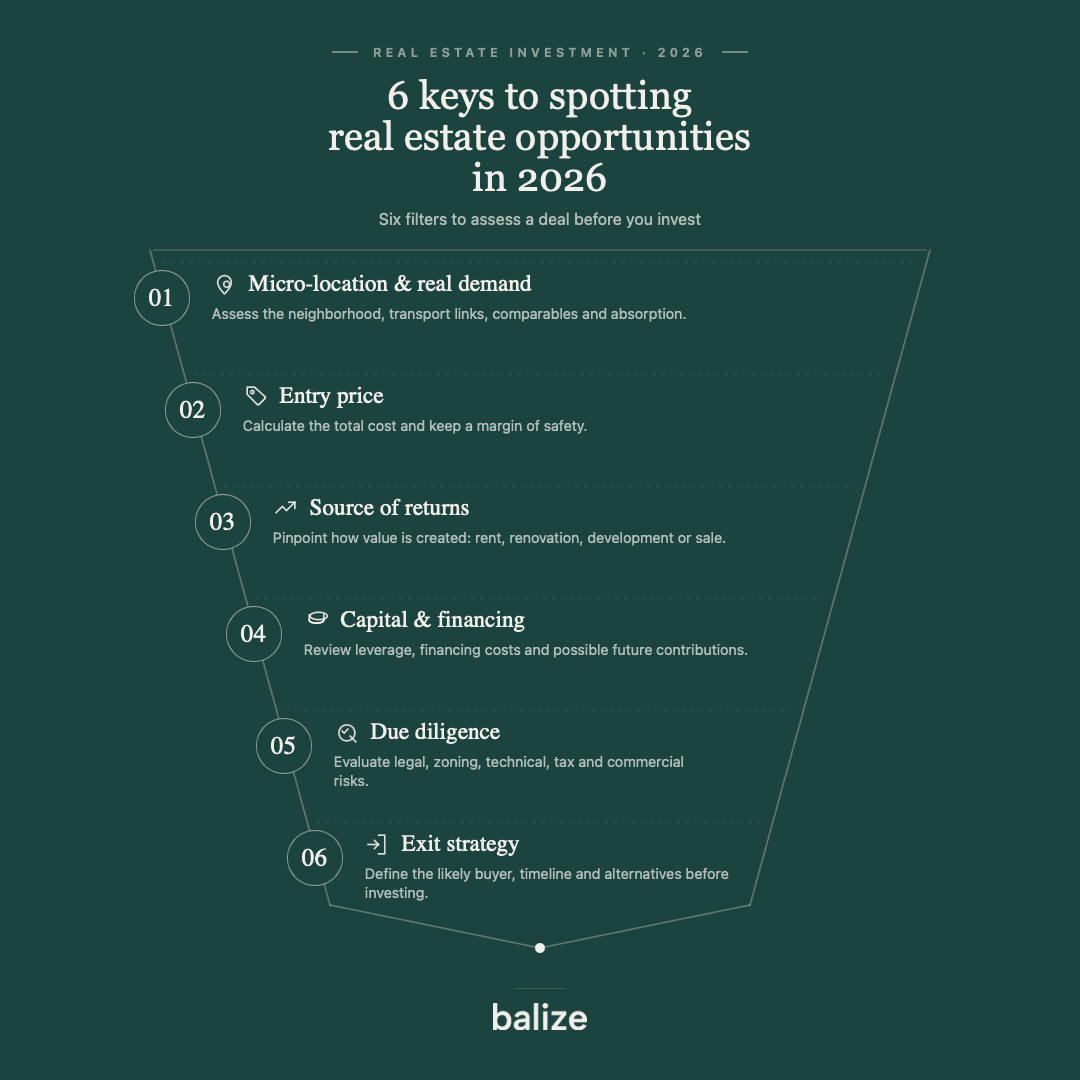
1. Analyse the micro-location and actual demand
The city is only the first filter. The performance of an investment can vary significantly from one location to another depending on transport connections, local amenities, competing supply, the profile of potential buyers or tenants and the development of the surrounding neighbourhood.
The analysis should be based on comparable transaction prices, rather than solely on advertised prices. It is also important to examine how long assets remain on the market, which property types attract the strongest demand and what rental or sale price can realistically be sustained under a conservative scenario.
The strongest real estate investment opportunities tend to appear where there is identifiable demand and a reasonable difference between the total cost of the transaction and the value that the market is likely to recognise.
2. Review the entry price and margin of safety
The entry price determines a substantial part of the final result. Even a well-located asset can become a poor investment if it is acquired without sufficient margin to cover taxes, financing, refurbishment works, marketing costs and unforeseen expenses.
Before investing, the total cost through to the project’s exit or stabilisation must be calculated. It is also advisable to compare the expected scenario with a more conservative scenario, incorporating possible delays, lower income or higher costs.
A margin of safety does not eliminate risk, but it reduces the project’s dependence on every assumption being met exactly as forecast.
3. Identify where the return will come from
Not all real estate investment strategies generate returns in the same way. In some transactions, returns come from rental income. In others, they may depend on property development, refurbishment, repositioning, acquisition at a discount, the sale of individual units or the resolution of a complex situation.
Before participating, investors should be able to answer a straightforward question: “What needs to happen for this project to create value?”. The answer must be specific and measurable. It is not enough to assume that the market will continue to rise. Value creation must be linked to an executable strategy, proven demand and reasonably estimated costs.
4. Calculate all capital and financing requirements
The analysis does not end with the initial investment. Some real estate projects require subsequent contributions, bank financing, milestone payments or additional resources if delays occur. It is therefore necessary to review:
- The level of leverage.
- The cost of financing.
- The payment schedule.
- Any anticipated future capital contributions.
- The project’s ability to absorb deviations.
- The effect of an extended timeframe on the final return.
An attractive projected return can deteriorate rapidly if financing is more expensive than expected or if the capital remains tied up for longer.
5. Assess risks through comprehensive due diligence
Proper real estate due diligence should review the legal, planning, technical, tax, financial and commercial position of the asset. Its purpose is not to confirm a decision that has already been made, but to identify factors that could alter the price, timetable or even the viability of the transaction.
Licences, charges, occupancy, the condition of the building, contracts, taxes, regulations, construction budgets and exit demand must all be analysed before committing capital.
When analysing real estate projects, risks should not be presented merely as a generic warning. Their probability, financial impact, the stage at which they could arise, the measures planned to mitigate them and their effect on returns and timelines should all be identified.
6. Define the exit strategy before investing
The exit strategy should form part of the initial analysis. It is necessary to determine who could purchase the asset, within what timeframe, under which conditions and what alternatives would be available if the main scenario does not materialise. A transaction may appear profitable on paper while still having limited exit options due to the investment size, asset type, regulation or lack of potential buyers.
The clearer the exit strategy, the easier it will be to assess the actual investment period and compare the expected return with the level of risk assumed.
Real estate segments with the strongest outlook for 2026
Although no sector is free from risk, the forecasts available at the beginning of the year point to several segments with particularly strong fundamentals for real estate investment in 2026. Structural demand, limited supply, changing consumer behaviour and emerging social and technological needs are expected to shape a significant proportion of market activity.
Living: affordable housing and new residential formats
The living sector will continue to play a prominent role due to the imbalance between household formation and the availability of housing in certain urban areas.
In addition to traditional housing, segments such as student accommodation, flex living, affordable housing and senior living respond to specific demographic and residential needs.
However, their attractiveness will depend on factors such as regulation, land costs, the affordability of the product, local demand and the capabilities of the operator.
Hotels: established destinations, conversions and emerging markets
The hotel sector enters 2026 from a strong position, supported by dynamic tourism demand and increasing expenditure per visitor.
Opportunities may be found in established destinations, markets with room for further development, building conversions and transactions aimed at improving the category or positioning of an asset.
Within this segment, location, seasonality, the operator and the investment required to increase revenue will be decisive.
Logistics: stable demand and limited suitable supply
The logistics sector is expected to maintain a stable outlook across the main corridors and certain regional hubs linked to e-commerce, urban distribution and the reorganisation of supply chains.
The strongest opportunities are likely to be found in well-connected, technically suitable assets located in markets with limited supply. The quality of the property and the financial strength of the tenant will carry more weight than the overall growth of the sector.
Offices: a selective recovery focused on high-quality assets
The office market will continue to show selective performance.
Efficient, well-connected buildings located in established business districts may benefit from a limited supply of high-quality space. By contrast, obsolete properties will need to compete through refurbishment, repositioning or changes of use where these are viable.
Data centres, healthcare and alternative assets
Digitalisation, artificial intelligence and an ageing population will continue to drive interest in data centres, healthcare assets and other specialised infrastructure.
These segments offer potential, but also present higher barriers to entry. They require technical expertise, specialist operators, complex contracts and a rigorous assessment of their energy and regulatory requirements.
Overall, the living and hotel sectors enter 2026 with particularly strong momentum, while logistics, high-quality offices and alternative assets are likely to offer more selective opportunities. The different ways of participating in these markets correspond to different real estate investment strategies.
Accessing real estate projects without purchasing an asset directly
Direct ownership is not the only way to participate in the market. Investors can also access structured transactions through a private investors’ club and achieve greater real estate diversification without having to manage each asset individually.
At balize, real estate projects undergo financial, technical, legal and commercial analysis before being presented to the club. Each opportunity follows a specific strategy based on the asset, the market, the expected timeframe and the way in which the return is expected to be generated.
Starting from €10,000, investors can participate in different transactions without purchasing or managing an individual property, allocating their capital across the projects that best match their objectives.
The model provides access to real estate investment with prior selection, operational monitoring and a strategy defined from entry through to exit. To understand how this differs from other collective models, you can read our comparison of real estate crowdfunding and a private investors’ club.
Conclusion: investing with sound judgement in 2026
Real estate investment in 2026 will take place in an active market with several segments offering favourable prospects. However, neither rising prices nor the attractiveness of a particular category can, on their own, guarantee the outcome of a transaction.
A genuine opportunity will arise when four elements coincide: a suitable asset, a reasonable entry price, an executable strategy and an exit supported by actual demand.
The investor’s advantage will therefore not simply lie in identifying a trend before others. It will lie in knowing how to reject transactions that do not offer sufficient margin and recognise those in which the market, price, risk and execution are properly aligned.
At balize, we will continue to apply these criteria when selecting real estate projects and presenting our private investors’ club with opportunities that have been analysed, structured and monitored throughout their entire lifecycle.
Frequently asked questions about real estate investment in 2026
Is 2026 a good time to invest in real estate?
The starting environment is favourable: real estate investment in Spain ended 2025 with growth of 31%, while house prices increased by 12.8% year on year. However, a rising market does not guarantee the outcome of every transaction. What matters is not the market timing in isolation, but whether the specific asset, its entry price, the strategy and the exit are properly aligned.
What factors determine whether a real estate transaction is a good opportunity?
The six key factors are: the micro-location and actual demand, the entry price and margin of safety, the specific source of the return, capital and financing requirements, due diligence covering legal and technical risks, and the exit strategy. A robust transaction should withstand analysis across all six areas, rather than performing well in only one.
Which real estate segments have the strongest outlook for 2026?
The living sector (student accommodation, flex living and senior living) and the hotel sector enter 2026 with the strongest momentum due to imbalances between supply and demand. Logistics, high-quality offices and alternative assets such as data centres and healthcare facilities may offer more selective opportunities, with higher barriers to entry.
How can I invest in real estate without purchasing an asset directly?
An alternative to direct ownership is to participate in structured projects through a private investors’ club. At balize, projects undergo financial, technical, legal and commercial analysis before being presented to the club, and investors can participate from €10,000 without having to manage the asset individually.
What is the difference between real estate crowdfunding and a private investors’ club?
Real estate crowdfunding is an open and standardised model, generally aimed at retail investors, with lower entry amounts and limited scope for conducting their own analysis. A private investors’ club applies greater project selection, more in-depth analysis and a closer relationship with the management team.