


A Family Office is a professional structure dedicated to the comprehensive management of a family's wealth. It can coordinate investments, risk management, tax and succession planning, reporting and other aspects related to wealth management. Unlike an approach focused solely on a financial portfolio, its scope can cover the family's entire range of assets and financial needs.
This comprehensive approach makes concepts such as diversification, wealth preservation, liquidity and alternative investments particularly relevant. Fixed income, equities, private equity, private markets and real estate can all form part of the same strategy depending on each family's objectives, investment horizon and risk profile.
In this article, we explore what a Family Office is, how it works, the different types of Family Offices and how they invest. We also explain the differences between a Single Family Office and a Multi Family Office and examine the role real estate can play in managing substantial private wealth.
What is a Family Office?
A Family Office is a structure created to centralise and professionalise the management of the wealth of one or more families. Its role is to coordinate different financial and wealth-related decisions under a common strategy, taking into account factors such as investment, risk, liquidity, taxation, succession and long-term objectives.
It should therefore not be understood simply as an investment manager. Depending on the needs of each family, a Family Office may bring together professionals from different disciplines and coordinate financial, tax, legal and real estate advisers, as well as specialists in other asset classes.
The objective is to provide a consolidated view of the family's wealth, allowing decisions to be made based not only on the potential return of each investment, but also on how it affects the overall portfolio, the level of risk, liquidity requirements and the family's future objectives.
What does a Family Office do?
The functions of a Family Office can range from investment management to wealth and succession planning. Its scope will depend on the size and complexity of the wealth being managed and the specific needs of each family.
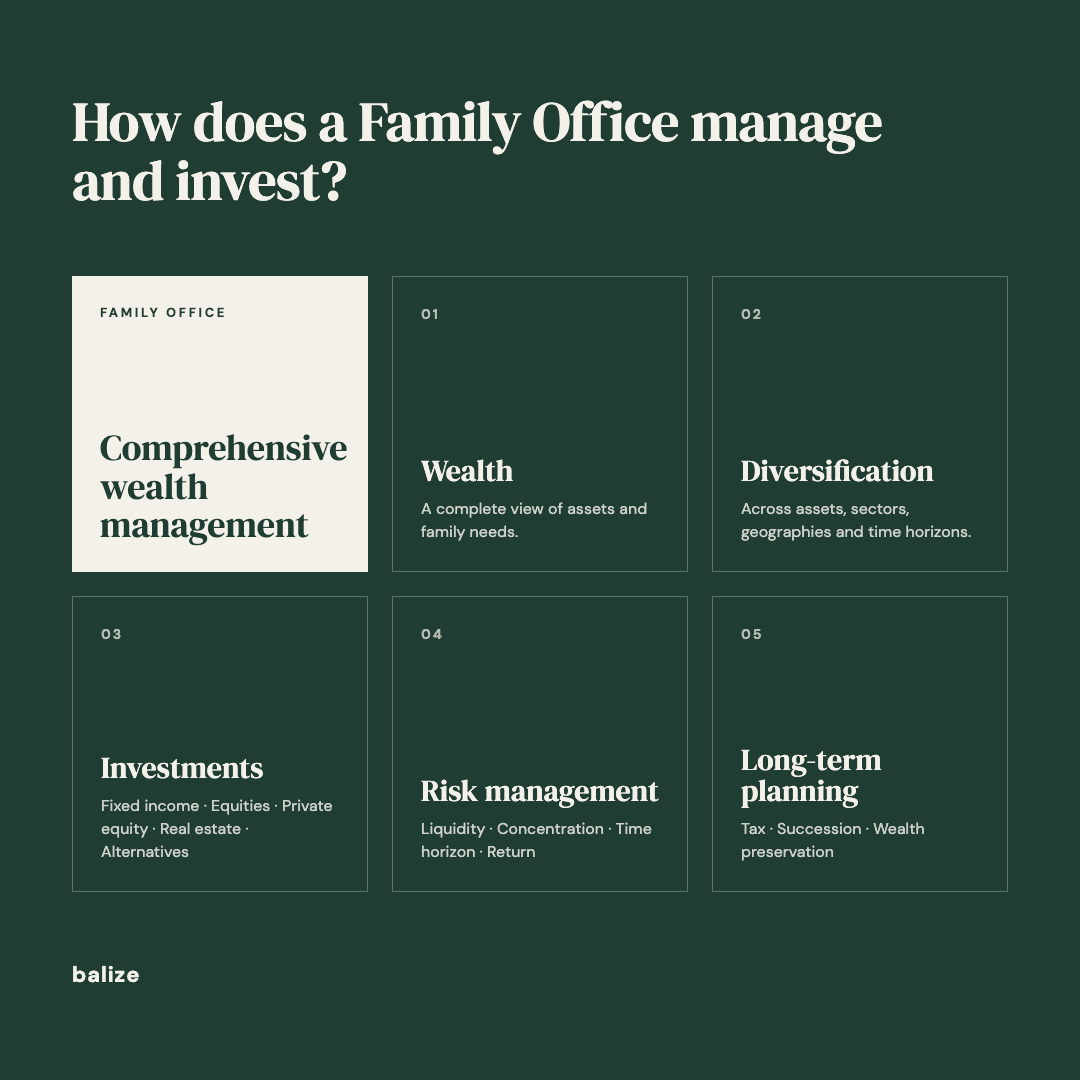
Its main functions may include:
This perspective makes it possible to assess each decision as part of a broader strategy. An investment may appear attractive in isolation and yet be unsuitable if it excessively increases portfolio concentration, has an investment horizon that is incompatible with the family's objectives or significantly reduces available liquidity.
Are a Family Office and an HNWI the same thing?
No. A Family Office and an HNWI are different concepts, although they are closely related. HNWI stands for High Net Worth Individual and refers to a person with substantial wealth, while a Family Office is a structure that can be used to organise and manage family wealth.
Therefore, HNWI describes an investor profile, while Family Office describes a wealth management structure.
This distinction becomes increasingly important as wealth becomes more complex. The existence of companies, real estate assets, financial investments, business holdings or alternative investments may create a need for more coordinated and professional wealth management.
If you would like to explore this investor profile in greater detail, you can read our article on how High-Net-Worth Individuals invest in real estate.
Single Family Office vs Multi Family Office: what are the differences?
The main difference between a Single Family Office and a Multi Family Office is the number of families served by the structure. A Single Family Office serves one family exclusively, while a Multi Family Office manages or advises several families while sharing part of its resources and infrastructure.
Single Family Office |
Multi Family Office |
|
| Number of families | One family. | Several families. |
| Customisation | A structure specifically designed around the needs of one family. | Services adapted to each family within a shared infrastructure. |
| Infrastructure | Owned by or dedicated exclusively to the family. | Shared resources and professionals. |
| Costs | The family bears the cost of maintaining its own structure. | Some resources and costs can be shared among different clients. |
| Choosing the model | Depends on the complexity of the family's wealth, its needs and the level of control required. | Depends on wealth management needs and the level of services required. |
Single Family Office
A Single Family Office (SFO) works exclusively for one family. Its structure, team, processes and strategy are designed around that family's needs and the specific characteristics of its wealth.
This model provides a high degree of customisation and control, although it also requires the family to bear the costs associated with the team, technology, administration and professionals required to operate the structure.
Multi Family Office
A Multi Family Office (MFO) provides services to several families, allowing them to share part of the infrastructure and resources required for wealth management.
Each family maintains its own objectives and strategy, but certain functions can be centralised. The choice between the two models will depend on factors such as the complexity of the family's wealth, the level of customisation required, the resources available and the desired degree of control.
Family Office vs traditional wealth management: what is the difference?
A Family Office can take a broader approach than the management of a financial investment portfolio. In addition to investments, it can coordinate real estate holdings, business interests, corporate structures, succession planning and other family assets.
The main difference therefore lies in the holistic view of wealth. Rather than focusing solely on how much a particular investment may generate, a Family Office considers the role that investment plays within the family's overall wealth strategy.
This means simultaneously assessing factors such as potential returns, investment risk, capital availability, investment horizon and existing concentration in specific asset classes.
How does a Family Office invest?
A Family Office can allocate wealth across different asset classes to build a strategy tailored to the family's objectives. There is no standard portfolio: its composition will depend on the source of the family's wealth, liquidity requirements, investment horizon and risk tolerance.
Different investment categories may include:
Diversification is not simply about accumulating different investments. Its purpose is to avoid excessive concentration of wealth in a single asset, sector, market or source of return.
A Family Office may also combine investments with different time horizons. While certain positions offer greater liquidity, others may require capital to remain invested for several years in order to execute a business or real estate strategy.
Within real estate, there are also different risk profiles and investment approaches. In our guide to real estate investment strategies, we explain the differences between the main approaches to investing in property.
What role do alternative investments play in a Family Office?
Alternative investments allow a portfolio to incorporate assets and strategies beyond traditional fixed income and listed equities. This universe can include private equity, venture capital, infrastructure, private markets and certain real estate strategies.
They may be incorporated with different objectives in mind, such as diversifying sources of return, accessing private markets or participating in projects where value creation depends on active management.
However, these investments can also involve lower liquidity, longer investment horizons and specific risks. They should therefore be assessed within the context of the family's overall wealth and future capital requirements.
Why do Family Offices invest in real estate?
Real estate can form part of a Family Office's strategy because it provides exposure to real assets and access to different sources of return and value-creation strategies. Its role within the portfolio will depend on the type of asset, the investment strategy and the investor's objectives.
Investing in real estate does not mean following a single strategy. The sector includes approaches focused on recurring rental income, property development, refurbishment, asset repositioning and projects based on acquiring, transforming and subsequently selling an asset.
This diversity makes it possible to assess opportunities according to factors such as risk, timeframe, liquidity, value-creation potential and exit strategy.
Before participating in a project, it is essential to analyse the location, entry price, demand, expected costs, timeline, financing and potential exit scenarios.
To explore this process in greater detail, you can read our guide on how to analyse a value-add real estate project, where we explain the main factors that should be reviewed before investing.
What does a Family Office analyse before investing in a real estate project?
Before investing in a real estate project, a Family Office should analyse how the return is expected to be generated, which risks the transaction involves, how long the capital is expected to remain committed and how the exit strategy will be executed. The target return is only one part of the analysis.
Some of the main factors that may be assessed include:
It is also important to distinguish between the different metrics used to compare projects. The total return of a transaction does not provide the same information as an annualised metric that takes into account the period during which capital remains committed.
In our guide to gross returns, net returns and IRR in real estate investment, we explain how these metrics should be interpreted and why the investment timeframe can significantly affect comparisons between different projects.
Private investment clubs and access to real estate opportunities
A Family Office does not necessarily need to source, acquire and directly manage every real estate project in which it wants to participate. It can also access opportunities selected and managed by specialised teams.
This allows investors to assess different opportunities and decide which ones fit their strategy without having to take on the entire operational management of each project directly.
Private investment clubs can provide access to these types of opportunities, particularly when transactions require sourcing, technical and financial analysis, execution, ongoing monitoring and a subsequent exit strategy.
This model should not necessarily be confused with other forms of collective investment. In our comparison of real estate crowdfunding and the balize investment club, we explain some of the main differences.
How does balize analyse real estate investment opportunities?
At balize, every potential opportunity is analysed before it is presented to our private investors' club. The analysis considers different dimensions of the project in order to understand both its potential and the risks associated with the transaction.
Broadly speaking, the process can be structured into four areas:
1. Sourcing and analysis: identifying the asset, assessing its location and carrying out the initial opportunity analysis.
2. Project validation: technical, legal and urban planning review, preparation of the financial model and risk analysis.
3. Execution and monitoring: project coordination and control of costs, timelines and potential deviations.
4. Commercialisation and exit: defining the commercial strategy, monitoring the sale process and closing the transaction.
Members of the club can assess each opportunity individually and decide whether its risk, timeframe and target return are aligned with their own investment strategy.
Frequently asked questions about Family Offices
What does Family Office mean?
Family Office literally refers to an office dedicated to managing the affairs of a family. In the financial and wealth management sector, the term describes a professional structure dedicated to coordinating and managing the wealth of one or more families.
What does a Family Office do?
A Family Office can manage investments, monitor risk, coordinate tax and legal planning, organise wealth succession and consolidate a family's financial information. Its specific functions will depend on the needs and complexity of each family's wealth.
What is the difference between a Family Office and an HNWI?
An HNWI is an individual with substantial wealth, while a Family Office is a wealth management structure. An HNWI may therefore use the services or structure of a Family Office to organise and manage their wealth.
What is the difference between a Single Family Office and a Multi Family Office?
A Single Family Office serves one family exclusively, while a Multi Family Office provides services to several families. The former allows a completely dedicated structure to be developed, while the latter allows certain resources and infrastructure to be shared.
What does a Family Office invest in?
A Family Office may invest in fixed income, equities, funds, private equity, venture capital, real estate and other alternative investments. The allocation will depend on each family's objectives, liquidity requirements, investment horizon and risk profile.
Why might a Family Office invest in real estate?
Real estate provides access to real assets and different investment strategies, ranging from income generation to transformation and value-creation projects. Its inclusion will depend on how it fits within the family's overall diversification and wealth strategy.
Can a Family Office invest through a private investment club?
Yes. A Family Office can assess real estate opportunities sourced and managed by third parties and decide individually whether they fit its strategy. Participating through a private investment club does not eliminate investment risk, so each project should be assessed according to its structure, timeframe, target return and specific risks.
Conclusion
A Family Office provides a comprehensive approach to managing substantial private wealth by coordinating investments, diversification, risk, liquidity and long-term planning.
Within this strategy, real estate can perform different functions and provide access to a range of investment approaches. The key is not simply to select an asset class, but to understand how each opportunity fits within the family's overall wealth and appropriately assess the relationship between risk, return, liquidity and investment horizon.
Actively managed real estate strategies, such as value-add, seek to create value through the transformation and repositioning of assets. However, each project requires individual analysis and an appropriate assessment of its risks. If you are looking to diversify your wealth through selected real estate opportunities, you can apply for access to balize's private investors' club and explore the available projects.
*All real estate investments involve risk. Timelines, costs and results may differ from initial estimates. This content is for informational purposes only and does not constitute financial, tax, legal or investment advice. Before participating in any transaction, investors should review the specific documentation and assess whether the investment is appropriate for their profile, investment horizon and risk tolerance.