

High-net-worth investors have a particularly close relationship with the real estate market. For this profile, real estate is not merely a way to acquire property, but a tool to preserve capital, diversify wealth and access opportunities with a clearly defined investment strategy. In Spain, high-net-worth investors’ interest in real estate investment remains closely linked to residential assets, repositioning projects, value-add opportunities and co-investment structures in specific projects.
In this context, real estate investment for high-net-worth individuals requires an increasingly professionalised approach. It is not only about accessing an asset, but about understanding the transaction as a whole: location, investment strategy, estimated timeframe, risks, documentation, legal structure and potential exit.
For this investor profile, value lies in analysing specific projects with a rigorous approach, assessing different scenarios and having sufficient information before making a decision. For this reason, asset selection, the quality of the preliminary analysis and execution capacity are determining factors in any real estate transaction.
What is a high-net-worth investor or HNWI?
In the international financial sector, high-net-worth investors are commonly referred to as HNWI (High Net Worth Individuals). In general terms, an HNWI is defined as an individual with investable assets of USD 1 million or more, excluding their primary residence, collectibles, consumables and durable goods.
There is also the Ultra-HNWI category, which refers to individuals with investable assets of USD 30 million or more. This distinction is relevant because not all private wealth profiles share the same objectives, investment approach or risk tolerance.
Some investors seek wealth preservation and stable income streams. Others prioritise growth, opportunities with greater revaluation potential or more active investment strategies. In all cases, real estate can play an important role, as it allows investors to access specific assets linked to real market needs.
Source: Capgemini Research Institute. World Wealth Report 2025.
Key reasons why real estate attracts high-net-worth investors
1. Tangibility
Unlike other financial instruments, real estate assets are physical, identifiable and can be assessed using relatively clear parameters: location, condition, demand, price, return and liquidity.
2. Diversification
Real estate investment can complement portfolios made up of equities, fixed income, cash, private companies or other alternative assets. This diversification does not eliminate risk, but it can provide a different type of exposure when opportunities are carefully selected.
3. Active value creation
In certain transactions, the outcome does not depend solely on the general evolution of the market, but also on the ability to transform the asset: renovating it, repositioning it, improving its use, optimising its commercialisation or executing an exit strategy.
For this reason, many high-net-worth profiles do not view real estate solely as a passive investment. They approach it as an asset class where management, execution and local market knowledge can make a meaningful difference.
Spain as an attractive market for real estate investment
Spain remains a relevant market for real estate investment thanks to its combination of residential demand, tourism appeal, economic activity, liquidity in major cities and repositioning opportunities.
According to CBRE, real estate investment in Spain exceeded €18.45 billion in 2025, 31% more than in 2024. In addition, the first quarter of 2026 recorded €6.3 billion in investment, representing a 93% year-on-year increase.
These figures show an active market, but they should not be interpreted as a guarantee of returns. For a high-net-worth investor, the key remains to select specific transactions carefully, analyse the location, review the entry price and understand the exit plan. Madrid, Barcelona, certain provincial capitals and coastal areas with solid demand may offer opportunities, but each asset must be assessed individually. A strong city does not automatically make every property a good investment.
Common real estate investment strategies among HNWI
There is no single way to invest in real estate. HNWI may combine different strategies depending on their profile, investment horizon, available liquidity and desired level of involvement.
Stabilised assets: income and preservation
One common strategy is to invest in stabilised real estate assets located in established areas and capable of generating recurring income. These assets may include rental housing, well-located retail units, offices, logistics assets or professionally managed residential products.
This approach often suits investors seeking stability and lower operational involvement. However, the expected return may be more limited, especially if the entry price is high or if the asset already reflects much of its potential value.
Value-add real estate: active value creation
Value-add real estate consists of acquiring assets with improvement potential in order to increase their value through renovation, repositioning, change of use, layout optimisation or commercial improvement.
This strategy may be particularly attractive for investors seeking transactions with a stronger management and transformation component. However, it also involves higher risks, such as construction cost deviations, delays, licensing issues, market changes or lower exit liquidity.
In a value-add real estate transaction, the key is not simply to buy at a low price. It is necessary to carry out thorough due diligence and assess in detail: what will be improved, how much it will cost, how long it will take, who will buy or lease the final product and what margin remains if market conditions change.
An older asset in a good location may appear to be an opportunity, but it only becomes one if the renovation is viable, the budget is well estimated, there is demand for the final product and the exit plan is realistic.
Investment in specific projects
Another common route for HNWI is to participate in selected real estate projects, where the investor accesses a specific transaction with documentation, preliminary analysis, an estimated timeframe and a defined investment strategy.
This type of real estate investment allows the investor to understand the asset, the investment rationale, the main risks and the exit plan from the outset. Unlike a more generic investment, the investor can analyse each project individually and decide whether it fits their profile.
For many high-net-worth investors, this approach can be attractive because it provides access to professionally managed opportunities without requiring them to personally take on the full operational burden of sourcing, acquiring, renovating, managing and exiting the asset.
What an HNWI analyses before investing in real estate assets
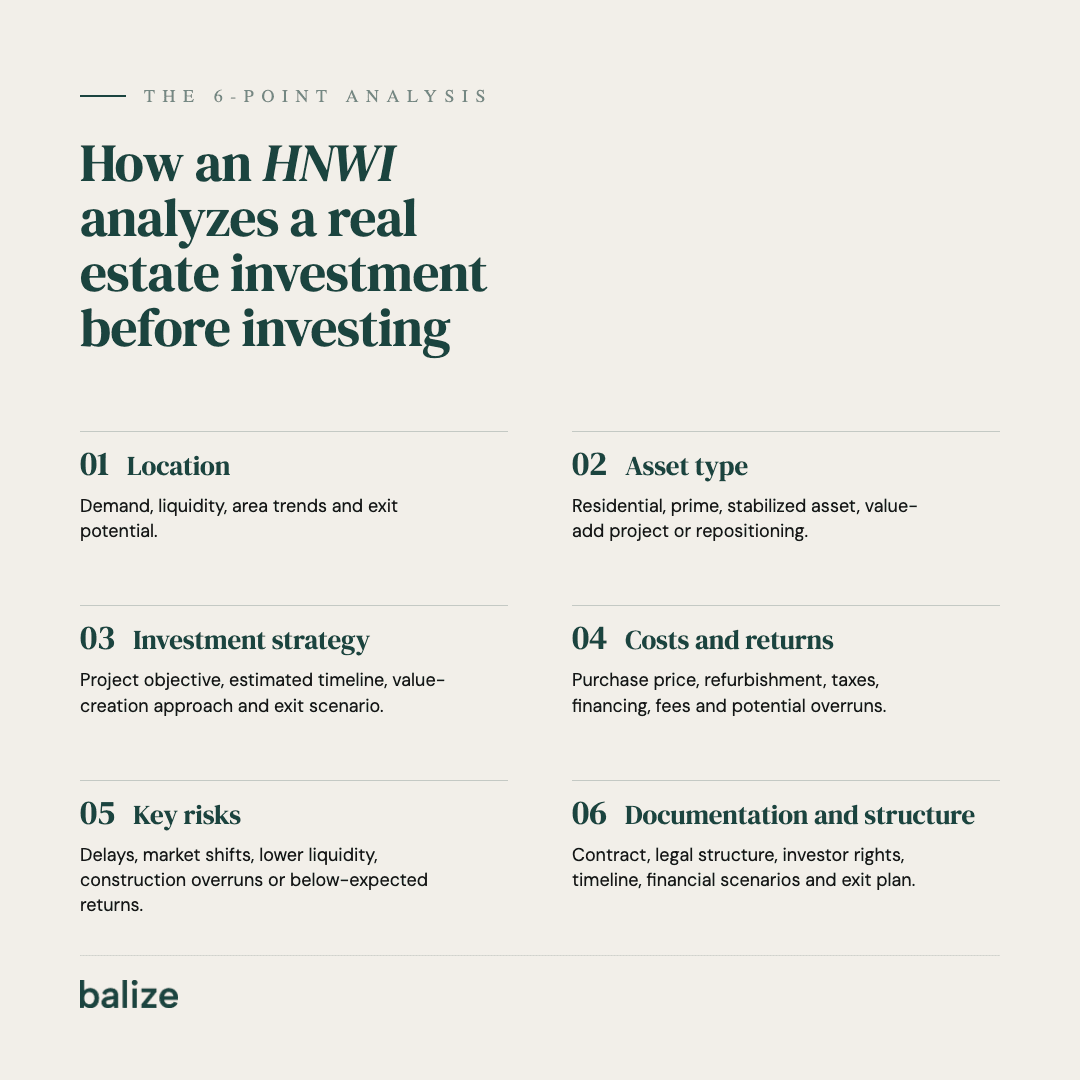
Before investing in real estate, an HNWI typically assesses several key factors. The first is location, as it directly influences demand, liquidity and the potential exit price. The second is the technical condition of the asset, particularly if it requires renovation or repositioning.
The cost structure is also analysed in detail: purchase price, taxes, financing, construction works, fees, commercialisation costs and potential deviations. In value-add real estate strategies, this point is critical, as an underestimated renovation budget can significantly reduce the project’s profitability.
Another key element is the timeframe. Real estate investment for high-net-worth individuals usually requires a clear timeline: entry, execution, stabilisation and exit. The more complex the project, the more important it becomes to anticipate alternative scenarios.
Finally, the legal and contractual structure must be reviewed. The investor should understand how they participate in the transaction, what rights they have, what risks they assume, how potential returns are distributed and what documentation supports the operation.
Risks high-net-worth investors should consider
Although real estate is an attractive asset class, it is not risk-free. High-net-worth investors should analyse each transaction with caution and avoid making decisions based solely on optimistic scenarios. The most relevant risks include an excessive entry price, administrative delays, renovation cost deviations, rising costs, limited liquidity, regulatory changes, financing conditions and shifts in demand.
In value-add real estate transactions, these risks become more significant because the outcome depends on the correct execution of the asset transformation. For this reason, it is advisable to analyse a base-case scenario, a conservative scenario and a stress scenario.
Professionalised real estate investment is not about eliminating risk, but about identifying, measuring and documenting it, and deciding whether it is adequately compensated by the expected return.
How Balize fits into real estate investment for high-net-worth investors
Balize can be a suitable option for high-net-worth investors seeking exposure to real estate through selected real estate projects, with preliminary analysis, specific documentation and professional follow-up. The model focuses on identifying opportunities, assessing the viability of the asset, structuring the transaction and supporting the execution of the project. This allows investors to access specific opportunities without directly assuming the full operational burden of sourcing, acquiring, renovating, managing and selling a property.
In particular, Balize focuses on projects where there may be a clear value creation strategy: repositioning, renovation, product improvement, commercial optimisation or defined exit strategies. This approach is aligned with investors seeking a more professionalised form of real estate investment for high-net-worth individuals, based on specific projects and detailed analysis.
Frequently asked questions about HNWI and real estate investment
What is an HNWI?
An HNWI, or High Net Worth Individual, is a person with investable assets of USD 1 million or more, excluding their primary residence, collectibles, consumables and durable goods. In the financial sector, this term is used to identify private investors with significant wealth and access to more specialised investment opportunities. In real estate, HNWI typically analyse transactions based on criteria such as return, risk, liquidity, taxation and wealth planning.
Why do HNWI invest in real estate?
HNWI invest in real estate because the asset class combines several characteristics that are relevant to this profile: it is tangible, it can contribute to wealth diversification and it provides access to opportunities with a defined investment strategy. In addition, certain real estate projects may generate income, capital appreciation or value creation through renovation, repositioning or active management. However, real estate also involves risks, which means each transaction should be assessed individually.
What type of real estate assets interest high-net-worth investors?
High-net-worth investors often analyse residential assets, prime assets, properties with repositioning potential, renovation opportunities and real estate projects with a clear exit strategy. They may also consider stabilised assets if they are seeking income and capital preservation, or value-add real estate opportunities if they are looking for greater value creation potential. The choice depends on each investor’s risk profile, investment horizon, available liquidity and wealth objectives.
What is value-add real estate?
Value-add real estate is an investment strategy that seeks to increase the value of an asset through renovation, repositioning, improved use, commercial optimisation or active management. Unlike a purely passive real estate investment, the outcome depends largely on the ability to execute the planned strategy correctly. For a value-add transaction to make sense, it is necessary to buy well, control costs, validate demand for the final product and have a realistic exit strategy.
What should be reviewed before investing in a real estate project?
Before investing in a real estate project, an HNWI should review the investment strategy, legal structure, risks, budget, timeline, technical documentation, financial scenarios and exit plan. It is also important to understand how the investor participates, what rights they have, what risks they assume and how potential results are distributed. The transaction should be aligned with their risk profile, investment horizon, liquidity needs and wealth objectives.
Conclusion
High-net-worth investors play a relevant role in the real estate market because they seek assets capable of combining capital preservation, diversification and value creation. For this profile, real estate is not merely an investment in property, but a strategic tool within a broader wealth portfolio.
Strategies can range from stabilised assets to value-add real estate opportunities, as well as specific projects with professional management and a clearly defined investment strategy. The key lies in selecting carefully, analysing risks, understanding the structure and having a realistic exit plan.
In this context, Balize can act as a gateway to selected real estate projects for investors seeking exposure to the market through professional analysis, detailed documentation and ongoing follow-up of each transaction. As with any investment, prior review, understanding the risks and ensuring alignment with the investor’s profile are essential before making a decision.
All real estate investments involve risk. Projects may be subject to delays, cost deviations, market changes, lower liquidity or results below initial expectations. Before investing, it is essential to review the specific documentation of each project, understand its structure, analyse different scenarios and assess whether the transaction is aligned with the investor’s risk profile, investment horizon and wealth objectives. This content is for informational purposes only and does not constitute financial, tax, legal or investment advice.