


Real estate investment in Madrid continues to hold a prominent position within the European market. The Spanish capital combines liquidity, market depth, residential demand, economic activity and the ability to attract both domestic and international capital.
However, in an increasingly competitive environment, investing in an attractive city is not enough. The key lies in selecting the right asset, analysing the entry price, understanding demand, controlling costs, assessing risks and defining a realistic exit strategy.
In 2026, Madrid may continue to offer relevant opportunities for real estate investors, but the attractiveness of the market must be supported by analysis, judgement and execution capability.
Madrid remains attractive, but the market requires deeper analysis
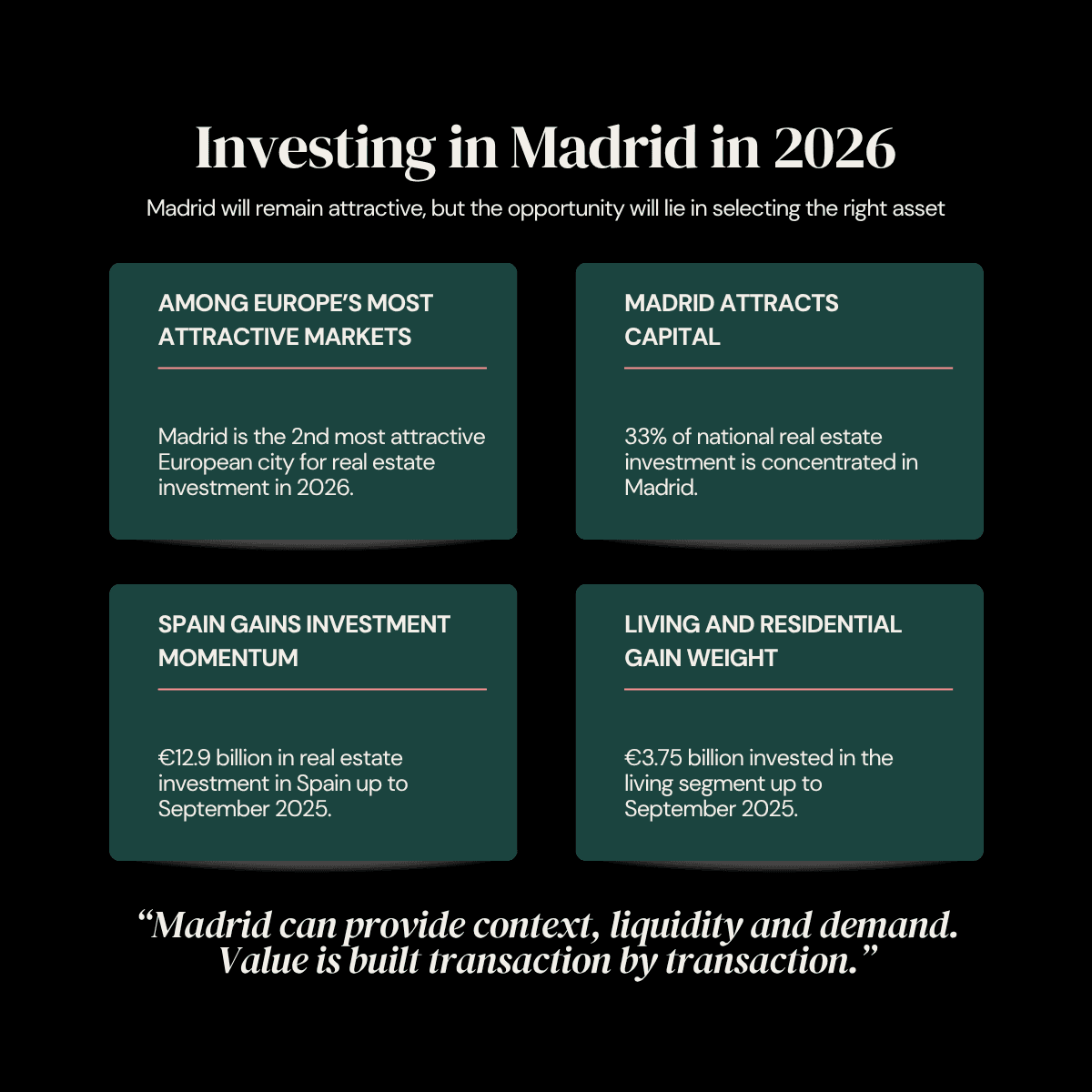
Madrid has consolidated its position as one of Europe’s most relevant real estate markets. According to theEmerging Trends in Real Estate Europe 2026 report by PwC and the Urban Land Institute, Madrid ranks as the second most attractive European city for real estate investment, behind only London.
Madrid in the European real estate investment ranking
The report places Madrid among Europe’s leading real estate capitals, alongside markets such as London, Paris, Berlin and Amsterdam. This position reinforces the city’s image as a liquid, deep market with a strong ability to attract investment. This appeal is driven by several factors: market size, connectivity, business activity, residential demand, relative stability, cultural offering and the capacity to concentrate different types of transactions.
Why the city’s appeal is not enough to invest well
The fact that Madrid is an attractive city does not mean that every asset located in the capital is a good investment. The city provides context, liquidity and demand, but profitability depends on the specific transaction.
Before investing, it is necessary to analyse the acquisition price, the condition of the property, expected costs, taxation, financing, timelines, target demand and exit strategy. For this reason, discussing real estate investment in Madrid should not be limited to a general reading of the market. Real opportunity is built asset by asset.
What the data says about real estate investment in Spain
Madrid’s appeal sits within a Spanish market that showed strong momentum throughout 2025.
€12.9 billion invested up to September 2025
According to CBRE, real estate investment in Spain reached €12.9 billion up to September 2025, representing year-on-year growth of 44%. In addition, the consultancy raised its forecast for year-end 2025, estimating that total volume could exceed €16.8 billion.
These figures point to an active market, with higher investment volumes and a progressive recovery in investor appetite. However, they also reflect an environment in which competition for quality assets may be high.
Madrid accounts for 33% of national investment
Within the Spanish market, Madrid continues to hold a particularly relevant position. According to CBRE, the capital accounts for 33% of national real estate investment, ahead of Barcelona, which represents 18%.
This confirms that Madrid remains one of the main focal points for real estate capital in Spain. The depth of the market, the presence of institutional and private investors, and the diversity of assets all help the city maintain a strong position.
However, for investors, market volume does not remove the need for analysis. In liquid and competitive markets, the difference may lie in the ability to identify assets with margin, understand risk properly and execute the transaction correctly.
Why Madrid remains a liquid market for investors
One of the main factors supporting real estate investment in Madrid is liquidity. The capital has a broad buyer base, strong business activity, residential demand and the presence of both domestic and international capital.
Market depth and international capital
Madrid offers a deeper market than less liquid locations. This facilitates capital entry and exit, which is particularly important for investors analysing projects with a sale, rental or refinancing strategy. Liquidity matters because the exit strategy is an essential part of the analysis. It is not enough to acquire an attractive asset: it must also be possible to sell, rent or refinance it under reasonable conditions.
Residential demand and shortage of updated product
Madrid continues to show strong residential demand, driven by employment concentration, labour mobility, appeal to domestic and international buyers, and the shortage of updated product in certain areas.
This combination can generate opportunities in assets that do not yet respond to current market demand. Older homes, obsolete layouts or properties requiring renovation can become more competitive products if they are properly analysed and executed.
The opportunity is not only in Madrid, but in the asset
Madrid’s appeal may create a positive perception of the market, but it should not replace the analysis of each individual transaction. A good city does not automatically turn every property into a good investment.
Location, entry price and comparables
Location remains one of the most important factors, but it must be analysed with precision. It is not enough to speak about Madrid in general terms: each district, street and micro-location can have different price, demand and liquidity dynamics. The entry price is also decisive. An asset may be located in a good area, but still not be a good opportunity if the price already reflects all of its future potential.
That is why comparable analysis is essential. It is advisable to review prices of similar assets, condition, specifications, surface areas, sales periods and differences between asking prices and actual closing prices.
Asset condition, costs and timelines
In renovation or repositioning transactions, the condition of the asset can completely change the viability of the project. An older property may seem attractive because of its location, but lose margin if it requires a more complex intervention than expected.
The total cost of the transaction should include not only the purchase price, but also taxes, renovation, technical fees, licences, financing, commercialisation and potential deviations. Timelines are also a financial variable. If a transaction takes longer than expected, financing costs may increase, the sale may be delayed and the annualised return may decrease.
Exit strategy and alternative scenarios
Before investing, the investor should have a clear exit strategy. The transaction may be structured for sale, rental, refinancing or long-term holding, but each alternative has different implications in terms of timeline, liquidity and profitability.
It is also advisable to work with alternative scenarios. A solid analysis is not limited to the base case: it should assess what happens if the sale takes longer, if the final price is lower or if costs increase. To explore how to evaluate an opportunity from a financial perspective, you can read our article onreal estate investment opportunities.
Value add in Madrid: when it can make sense
Value-add real estate can make sense in Madrid when there is a clear gap between the asset’s current condition and the value it could achieve after a well-executed improvement.
Assets with renovation or repositioning potential
Madrid has assets that may offer room for improvement: older homes in established areas, properties with inefficient layouts, buildings in need of updating or assets that are not positioned according to current demand. In these cases, value creation may come from renovation, redistribution, improved specifications, energy efficiency, design, commercialisation or repositioning of the final product.
Total cost, demand and expected final value
A value-add transaction is not simply about renovation. For it to make sense, the investor must verify that there is real demand for the final product, that the total cost leaves sufficient margin and that the planned exit is viable.
The profitability of a real estate investment does not depend solely on buying in a good location, but on correctly executing the planned strategy. If renovation costs increase, if the sale is delayed or if the final price does not reach expectations, the margin may be reduced. You can explore this concept further in our article on value-add real estate investments.
Living and residential: two relevant pillars of the market
The living segment has gained weight within real estate investment in Spain, and Madrid holds a prominent position within this trend.
The role of living in real estate investment
According to CBRE, up to September 2025 the living segment exceeded €3.75 billion, equivalent to 29% of total real estate investment in Spain. In addition, Madrid accounted for 42% of living investment. This confirms the growing importance of assets linked to housing, student accommodation, multifamily, flex living and other managed residential models.
What investors should review in residential assets
For investors, this trend does not mean that every residential asset is attractive. The key is to identify what product makes sense in each location, what buyer or end-user profile exists, what price the market can absorb and what level of risk the transaction implies. In Madrid, residential assets may continue to be a relevant category, but they require a rigorous reading of demand, regulation, costs, liquidity and the positioning of the final product.
What investors should analyse before investing in Madrid
Before making a decision on real estate investment in Madrid, several key aspects should be reviewed.
Specific location and micro-location
Madrid is not a uniform market. Each area has its own price, demand, liquidity and buyer profile dynamics. Analysing the micro-location helps better understand the real potential of the asset.
Entry price and margin of safety
The acquisition price conditions the entire transaction. Even in an attractive area, an overly tight purchase price may leave little room to absorb unexpected events. The margin of safety should take into account costs, timelines, financing, commercialisation and potential deviations.
Technical, legal and urban planning due diligence
Before investing, it is essential to review the technical condition of the asset, registry status, possible charges, urban planning regulations, required licences, homeowners’ association matters and any other element that could affect execution. A limitation that is not detected in time can affect the budget, the timeline or even the viability of the transaction.
Financial model and expected return
The financial model must include all transaction costs and should not depend solely on optimistic assumptions. It is advisable to analyse the base case, a conservative scenario and possible deviations. The expected return should be interpreted together with the timeline, risk, liquidity and execution capability.
Exit: sale, rental or refinancing
La estrategia de salida debe definirse antes de comprar. Una operación puede plantearse para venta tras reforma, alquiler, refinanciación o mantenimiento en cartera. Cada salida tiene un impacto distinto sobre la liquidez, la rentabilidad y el riesgo. Por eso, el inversor debe comprobar que la salida prevista está alineada con la demanda real del mercado.
Para entender mejor las distintas formas de invertir en real estate, puedes consultar nuestro artículo sobre estrategias de inversión inmobiliaria.
The exit strategy should be defined before acquiring the asset. A transaction may be structured for sale after renovation, rental, refinancing or long-term holding. Each exit route has a different impact on liquidity, profitability and risk. For this reason, the investor should verify that the planned exit is aligned with real market demand. To better understand the different ways to invest in real estate, you can read our article onreal estate investment strategies.
How balize fits into this context
At balize, real estate investment is understood as an end-to-end process. It is not only about accessing an asset, but about analysing the full transaction: market, location, property condition, structure, costs, risks, execution and exit.
The balize model is based on identifying selected real estate opportunities, analysing them beforehand, structuring the transaction and supporting project execution. This approach allows investors to access projects with analysis, documentation and professional monitoring, without directly assuming the full operational burden of the process.
In markets such as Madrid, where competition for quality assets is high, this methodology becomes especially relevant. The opportunity is not only in the city, but in the ability to select the right asset, acquire it with discipline, control execution and define a coherent exit.
FAQs on real estate investment in Madrid
Why is Madrid attractive for real estate investment?
Madrid is attractive because of its liquidity, market depth, economic activity, residential demand, connectivity and ability to attract domestic and international capital. It also ranks among the best-positioned European cities in specialised real estate sector reports.
What types of assets may have potential in Madrid?
Assets with potential may include residential properties requiring renovation, properties with obsolete layouts, buildings with repositioning potential, assets in established areas with a shortage of updated product and transactions with a clear exit strategy.
Is investing in Madrid enough to generate returns?
No. Madrid may offer a favourable context, but each transaction must be analysed individually. Profitability depends on the entry price, costs, timelines, execution, financing, demand and exit strategy.
What role does value-add real estate play in Madrid?
Value-add real estate can be relevant in Madrid because there are assets with improvement potential in areas with demand. This strategy seeks to create value through renovation, repositioning, product improvement or active asset management.
What should an investor review before investing in Madrid?
Investors should review location, entry price, comparables, technical condition of the asset, costs, financing, timelines, target demand, risks and exit strategy. The key is to analyse the full transaction, not just the city.
Conclusion
Madrid continues to hold a prominent position within the European real estate market and remains one of the most relevant destinations for real estate investment in Spain. Its liquidity, demand and market depth make it an attractive city for investors. However, in a competitive market, the opportunity does not lie only in investing in Madrid, but in selecting the right asset, analysing the transaction rigorously and executing it with professional capability.
In 2026, real estate investment in Madrid will continue to require judgement, analysis and management. The city may provide context, but value is built transaction by transaction.