


Investing in property to rent it out is one of the most common ways to gain exposure to the real estate market. The approach consists of acquiring a property, letting it and generating regular income through rental payments. However, the outcome of the investment does not depend solely on the purchase price and the expected monthly rent, but also on other factors that are not always taken into account.
Location, actual demand, acquisition costs, financing, maintenance and tenant management can significantly affect the final return. Therefore, before buying a property to rent out, it is important to analyse the entire transaction rather than focusing solely on its gross income.
Buy to Let: the strategy of buying a property to rent out
Buy to Let is a real estate investment strategy that consists of acquiring a property to place it on the rental market and generate recurring income. It may involve a second-hand property, a new-build home or a property requiring refurbishment before it can be offered for rent.
What defines the model is not the age of the property, but its intended purpose: the investor purchases the asset directly in order to operate it as a rental property. As the owner, the investor assumes responsibility for decisions relating to financing, upkeep, taxation, tenants and a potential future sale.
The return may come from the rental income received and from a potential increase in the value of the property. Nevertheless, the expectation of selling at a higher price should not be used to justify an investment that is not viable in its own right during the rental period.
Buy to Let, Build to Rent and PRS: key differences
Although all these concepts are related to rental housing, they should not be used interchangeably, as they describe different investment, ownership and management models. The main difference does not depend solely on whether the property is new-build or second-hand, but on the scale of the transaction, the origin of the asset, the ownership structure and the way in which it is operated.
For example, buying an individual property to rent out would normally be considered a Buy to Let strategy, whereas Build to Rent involves developing an entire residential scheme to be operated as rental housing under unified management. PRS, by contrast, more broadly encompasses the private rental housing market.
Understanding the differences between these models is important in order to avoid confusion and accurately assess the type of transaction being considered, the amount of capital required and the responsibilities that the investor will assume.
What it involves |
Asset type, scale and management |
|
Buy to Let |
A strategy in which an investor purchases a property with the aim of renting it out and generating regular rental income. What defines the model is the purpose of the purchase, not whether the property is new-build or second-hand. |
It may involve a new-build, second-hand or refurbished property. It is generally applied to an individual unit or a small portfolio. The owner either manages the rental directly or delegates the management to an agency or another third party. |
Build to Rent |
A residential development model in which a building or an entire scheme is designed and developed from the outset to remain in the rental market, rather than selling the homes individually. |
It is mainly associated with new-build developments, although some comprehensive refurbishments of entire buildings may follow a similar approach. Ownership and management are usually unified and professionalised. This model is common among developers, funds, insurance companies and SOCIMIs. |
PRS (Private Rented Sector) |
A broad concept encompassing the private rental housing market. It does not describe a single strategy, but rather the range of income-producing residential assets owned by private landlords and investors. |
It may include new or existing homes, entire buildings, residential portfolios or stabilised assets. The scale can vary, and management may be individual or professionalised, depending on the owner and the type of asset. |
Therefore, buying a new-build property and renting it out can still be considered Buy to Let. The difference from Build to Rent is not simply that the property is new, but that the entire development is conceived to remain in the rental market and operate as a single asset. This structure is explored in more detail in our analysis of what Build to Rent is and how it works.
What should you analyse before buying a property to rent out?
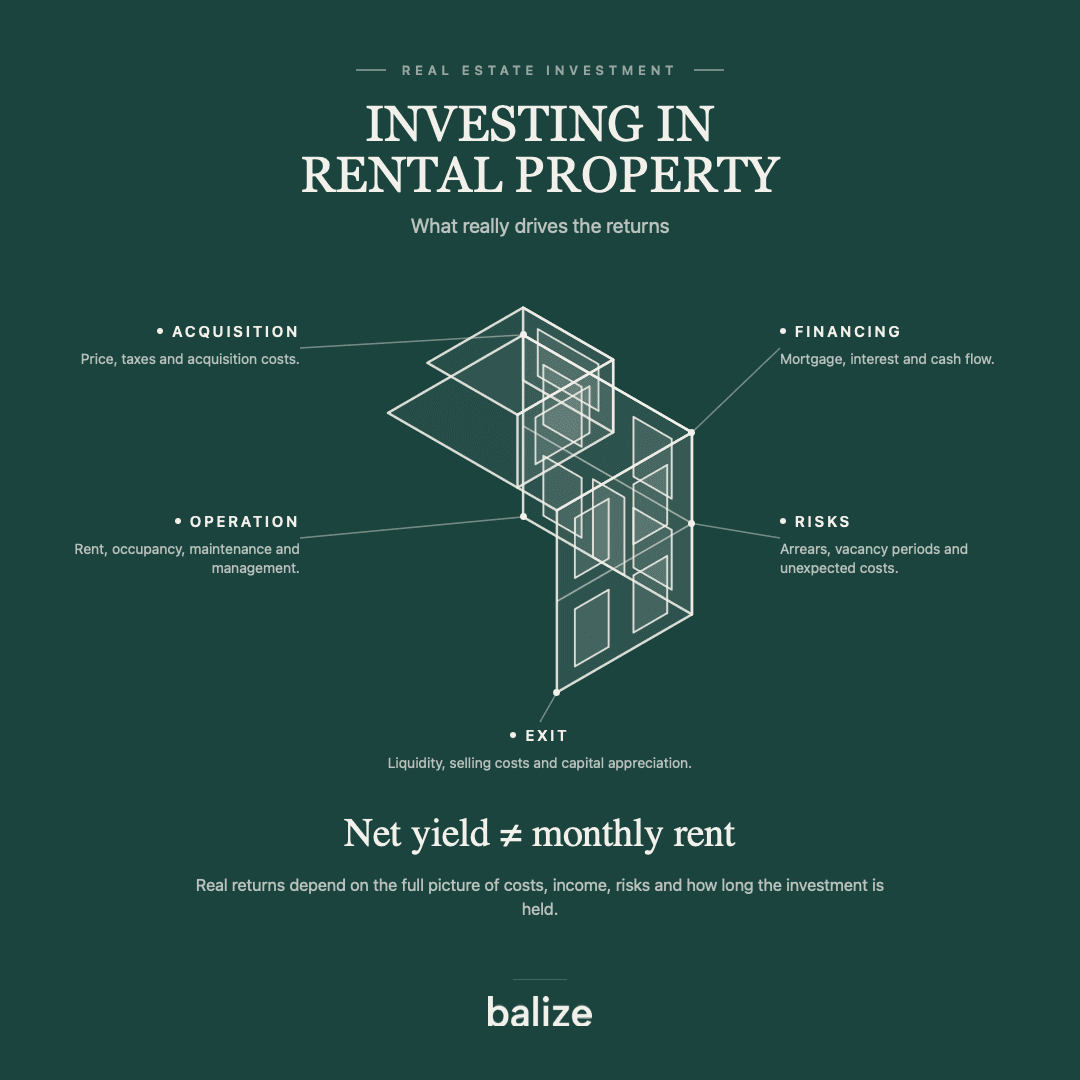
Total investment and net return
The actual cost is not limited to the purchase price. Taxes, notary fees, land registry fees, agency fees, refurbishment, furniture and financing must also be included. In addition, there are ongoing expenses such as service charges, insurance, maintenance, local taxes and management fees.
Gross yield provides an initial reference point, but net yield offers a more accurate picture of the return after expenses have been deducted. The main metrics are explained in our guide on how to calculate the profitability of a real estate investment.
Demand, location and achievable rent
It is not enough for a city to have strong rental demand. Investors should study the neighbourhood, the target tenant profile, the most sought-after property types, achievable rental levels and how long comparable properties take to let. It is also advisable to consider a conservative scenario. The rent advertised by other landlords does not always correspond to the rent ultimately agreed with the tenant.
Financing and cash flow
When a mortgage is involved, the analysis must include the monthly repayment, interest, associated insurance products and potential changes in financing costs. A transaction may offer an attractive gross yield and still generate limited or negative cash flow.
Condition of the property and future costs
Before purchasing, it is advisable to review the condition of the installations, potential extraordinary service charges, energy efficiency, refurbishment requirements and expected maintenance. An unforeseen expense can affect several years of rental income.
Management, regulation and taxation
The owner must select tenants, manage rent collection, resolve issues and maintain the property, unless these responsibilities are delegated. The regulations applicable to residential lettings and the tax treatment of income and expenses must also be considered.
Exit strategy
It is advisable to define from the outset when and under what conditions the asset would be sold. Liquidity, transaction costs and the potential target buyer are also part of the investment analysis.
Main risks of buying a property to rent out
Investing in property to rent it out can generate recurring income, but it also involves risks that directly affect returns, cash flow and the ability to recover the invested capital.
Vacancy periods and non-payment
The property may remain vacant between one tenant and the next, particularly if the rent is above the market level, the property requires improvements or demand in the area is limited. During these periods, the owner stops receiving rental income but must continue paying the mortgage, service charges, insurance and other expenses.
There is also a risk of non-payment. Even when tenants are assessed beforehand, delays or defaults may occur, generating legal costs and reducing the expected income.
Refurbishment, maintenance and unforeseen expenses
A major breakdown, an extraordinary service charge, the replacement of installations or a refurbishment that costs more than expected can affect several months or even years of rental income. Therefore, before buying a property to rent out, it is not enough to inspect the interior of the home. The building, communal areas, installations, energy efficiency and any potential upcoming works should also be analysed.
Concentration of capital
Purchasing a property usually requires the investor to allocate a significant amount of capital to a single asset. This concentrates the risk in one location, one property and, in many cases, one tenant. If the home remains vacant, requires major refurbishment or becomes less attractive than other properties in the area, the impact is felt across the entire investment.
Liquidity and exit costs
A property cannot be sold as quickly as many financial assets. Finding a buyer, negotiating the price and completing the transaction may take several months. In addition, the sale generates costs and taxes that must be incorporated into the overall return. For this reason, the exit strategy should be defined before the purchase, rather than only when the owner needs to recover the capital.
Regulatory and tax risk
Rental regulations, rent-review rules, contract duration requirements or the designation of rent-controlled areas may change and affect the investment. Taxes associated with the purchase, rental income and future sale must also be considered.
Another way to access the real estate market and diversify your investment portfolio
Investing in property to rent it out means acquiring the asset directly, assuming the purchase and financing costs and taking responsibility for refurbishment, maintenance and management. It also usually involves concentrating a significant portion of the investor's capital in a single property.
Compared with this direct investment model, the balize private investor club was created with the aim of democratising access to professional real estate opportunities. Starting from €10,000, members can participate in projects that have been previously selected, analysed and structured, without having to purchase or directly manage a property.
balize does not currently develop Buy to Let or Build to Rent strategies, nor operations intended to retain assets for rental income. Its proposition is an alternative for investors seeking exposure to the real estate market through projects with a defined value-creation and exit strategy.
Transactions may focus on refurbishment, repositioning, the acquisition of discounted assets or value-add strategies. Each opportunity is analysed individually, taking into account the entry price, forecast costs, timeframe, risks, value-creation potential and exit strategy. In this way, balize facilitates access to real estate investment through a professional approach and a more accessible entry ticket than purchasing a property directly.
Request access to the balize private investor club to stay informed about the latest news and discover upcoming investment opportunities.