

Build to Rent in Spain has become one of the residential models attracting the greatest interest in recent years. Against a backdrop of strong demand for rental housing, limited professionally managed supply in certain cities and growing institutional interest in managed residential assets, the model has gained increasing visibility.
Understanding this approach, however, requires more than simply translating the term as “building to rent”. It is important to examine how it works, how it differs from a traditional residential development, why it attracts institutional investors and which risks should be assessed before considering this type of transaction.
What does Build to Rent involve?
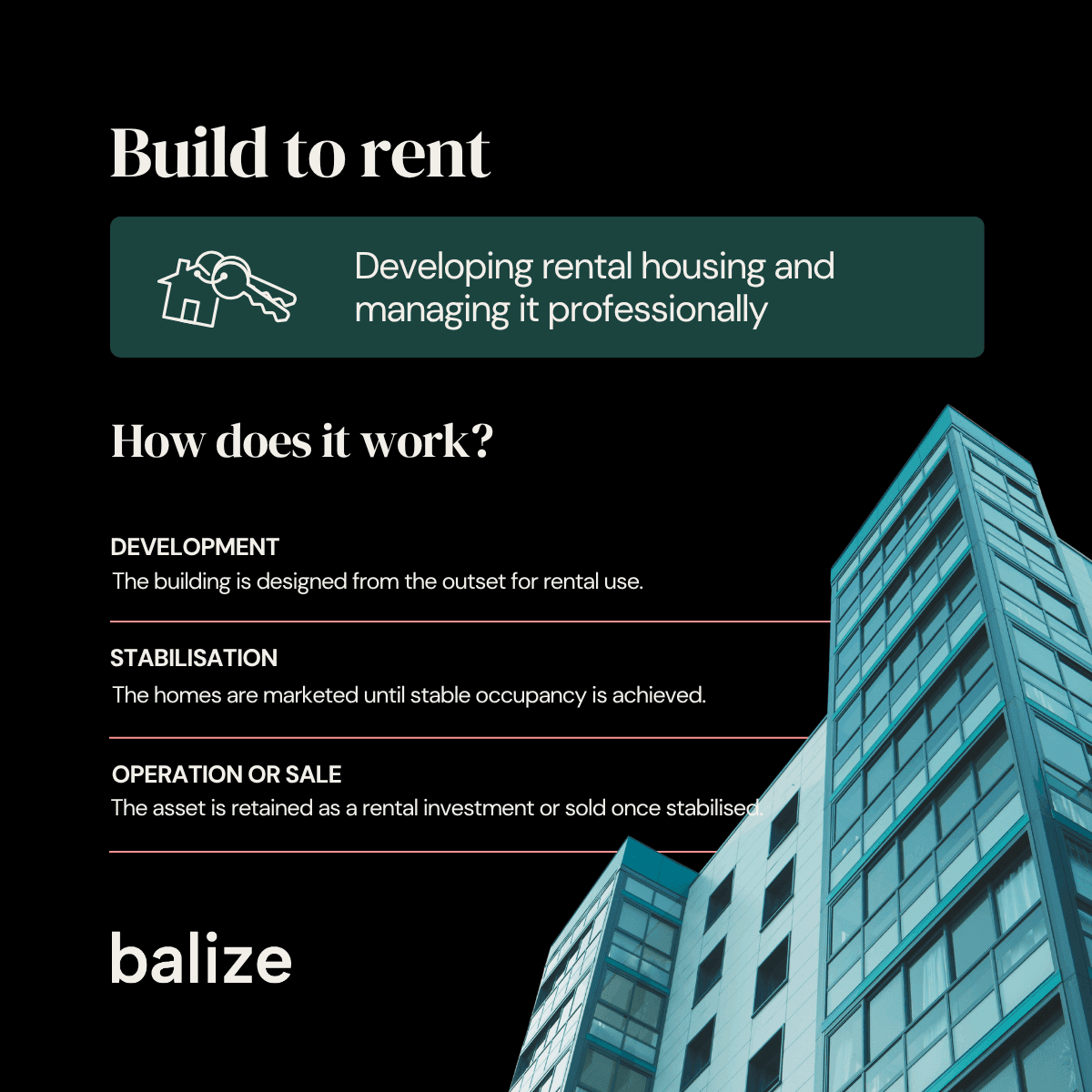
Build to Rent is a residential development model in which a building is designed, developed and managed from the outset for rental use. Unlike a traditional development, where homes are built to be sold individually, the asset is retained and operated to generate recurring rental income.
The defining feature of the model is that the building is conceived as an operating asset. Rather than being analysed simply as a collection of individual homes, it is designed to attract tenants, maintain occupancy, control costs, support professional management and preserve value over time.
For this reason, the model is generally associated with projects of a certain scale, typically entire buildings or residential developments managed under a unified structure. It should not be confused with purchasing an individual property to rent out, which would generally fall under Buy to Let.
From Build-to-Sell development to rental housing
How does Build to Rent differ from a traditional residential development?
The main difference lies in the intended use of the asset. In a traditional build-to-sell development, the developer markets and sells the homes individually. In a residential development intended for rental, the building must operate efficiently over an extended period.
This approach influences both the design of the property and its financial analysis. Layout efficiency, the durability of materials, energy performance and ongoing maintenance become increasingly important. Instead of focusing primarily on the development margin, greater attention is given to projected rents, occupancy, operating costs and the value of the stabilised asset.
How is this type of transaction structured?
A Build to Rent transaction in Spain generally begins with the identification of a suitable plot of land or residential project with the potential to support rental housing. The analysis then considers local demand, the target tenant profile, achievable rents, construction costs, financing, the applicable regulatory framework and the potential exit strategy.
The development phase follows, during which the building must be designed around an operational rental model. The objective is not merely to construct housing, but to create an efficient asset that can be managed effectively. This includes considering communal areas, services, maintenance requirements, energy efficiency, operating costs and ease of management.
Once construction has been completed, the leasing and stabilisation phase begins. The objective is to reach an occupancy level that allows the asset to generate stable rental income. The owner can then retain the property as a long-term investment or sell it as a stabilised asset to a fund, insurer, Spanish REIT or SOCIMI, or another investor specialising in rental housing.
New development, full refurbishment or individual units: where the model begins and ends
One of the most common questions is whether Build to Rent always involves new development. In its strictest sense, the model begins with a project conceived from the outset for rental use. It is therefore primarily associated with new residential developments specifically designed to be rented and professionally managed.
However, some comprehensive refurbishment projects involving entire buildings may follow a similar approach. This occurs when an asset is redesigned as a whole to operate as professionally managed rental housing, with unified ownership or management, adapted services and a clearly defined operating strategy.
The model should not be confused with purchasing individual properties and renting them out. When an investor acquires, renovates and rents a single home, the strategy is generally closer to Buy to Let than to Build to Rent. The differences between these models are explored further in our article on investing in rental housing.
Build to Rent as a real estate investment model
Why does it attract institutional capital?
This model is particularly relevant to institutional investors because it combines scale, recurring income and centralised management. For certain investment funds, insurers, SOCIMIs and long-term investment vehicles, operating an entire rental building can be more efficient than managing a geographically dispersed portfolio of individual homes.
Once stabilised, the asset may be retained to generate long-term rental income or sold as an operational investment product. Its attractiveness nevertheless depends on factors such as land prices, development costs, financing conditions, achievable rents, projected occupancy and the regulatory environment.
What role does it play in Spain’s living market?
This type of asset is generally analysed within the broader living sector, a category that encompasses several forms of professionally managed residential accommodation. It should not be confused with models such as flex living or purpose-built student accommodation, as each responds to a different type of demand, operational structure and average length of stay.
According to CBRE’s report on Spain’s living market, investment in the multifamily segment reached €1.342 billion by September 2025, of which €1.170 billion related to Build to Rent. The wider living sector recorded approximately €3.730 billion in investment, accounting for 29% of total real estate investment during the period.
These figures reflect investors’ growing interest in rental housing, but they do not automatically make every transaction an attractive investment. The quality of the asset, its total cost and its ability to generate sustainable rental income remain decisive.
What are the main risks of this strategy?
Changes in land prices, construction costs, financing conditions or delivery schedules can reduce the expected return. Risk also exists during the stabilisation phase, when the building must achieve the occupancy levels and rents assumed in the financial plan.
Other factors include operating expenses, maintenance costs, tenant turnover, regulatory changes and liquidity on exit. Strong rental demand does not necessarily compensate for an excessive entry price or an imprudent financing structure.
Alternative ways to invest in real estate through balize
Build to Rent in Spain may be appropriate for large developers and institutional investors with the capacity to develop, finance and manage entire buildings over long investment periods. However, it is not the only way to gain exposure to real estate investment.
For investors seeking to participate in the market without directly purchasing, developing or managing a property, the balize private investor club provides access to professionally selected and structured real estate opportunities. Through the club, investors can participate in projects based on strategies such as refurbishment, repositioning, value-add transactions, the acquisition of discounted assets, and the transformation and subsequent sale of properties.
Each transaction is assessed individually, taking into account the entry price, projected costs, value-creation potential, associated risks and the proposed exit strategy. This approach provides access to different real estate investment opportunities and a range of real estate investment strategies, including value-add real estate investments.
Regardless of the model selected, the quality of the asset, the robustness of the financial analysis, the management of risk and the clarity of the exit strategy remain the determining factors.