

Renovating to sell can be an effective strategy for increasing a property's value before bringing it to market, but a renovation does not generate returns simply because it improves a property. For the strategy to make sense from an investment perspective, the expected increase in value must compensate for the cost of the renovation, the time required to complete it and the risks involved throughout the process.
That is why, before renovating a property to sell, it is important to analyse the asset as an investment: how much it costs to acquire, what improvements it requires, how much capital will need to be allocated to the renovation, what its potential value could be once the work is complete and what margin exists between the total cost of the operation and the expected sale price.
In this guide, we explore how to renovate to sell, which improvements can increase a property's value, how to assess whether the operation could be profitable and what factors should be considered before acquiring a property with this strategy in mind.
What does renovating to sell mean?
Renovating to sell means making targeted improvements to a property with the aim of increasing its appeal, adapting it to market demand and achieving a higher sale value.
From an investment perspective, the process can be divided into five stages:
This strategy is often associated with house flipping, although not every buy, renovate and sell operation has the same scope. Some properties require a complete renovation, while in others a lighter intervention may be enough to significantly improve their market positioning.
The key is identifying which improvements can create value and which simply increase the cost of the operation.
When is it worth renovating a property before selling?
Not every property needs renovation, and not every asset offers sufficient potential for value appreciation. Before deciding whether it is worth renovating a property to sell, investors should assess both the condition of the asset and the characteristics of its market.
Some of the main factors to consider include:
A property may be in poor condition and still not represent a good investment opportunity. If the purchase price is too high or renovation costs absorb almost all of the potential increase in value, the operation may no longer be attractive.
For this reason, when renovating to sell, the analysis should begin before acquiring the property, not when the renovation starts.
Which renovations increase a property's value?
The renovations that increase a property's value are those that improve features buyers genuinely value and are willing to pay for. This can vary depending on the location, property type and target buyer.
1. Improving the layout
An inefficient layout can significantly limit a property's appeal. Redistributing spaces, eliminating unnecessary corridors, integrating certain living areas or creating more functional bedrooms and rooms can transform how a property is perceived.
However, any modification should be assessed from a technical, regulatory and commercial perspective. Adding another room does not necessarily create value if it reduces the overall quality of the property.
2. Renovating kitchens and bathrooms
Kitchens and bathrooms often play an important role in how buyers perceive the overall condition of a property. Outdated installations, deteriorated finishes or obsolete layouts can become a barrier for certain buyers.
When renovating a property to sell, the objective should not be to install the most expensive materials, but to achieve a result that is consistent with the target market segment and expected sale price.
3. Updating installations
Older properties may require electrical, plumbing, heating, cooling or other technical systems to be upgraded. These improvements may be less visible than cosmetic changes, but they can be essential when repositioning certain assets and reducing potential future issues.
4. Improving energy efficiency
Windows, insulation, efficient heating and cooling systems and other improvements can help enhance a property's energy performance.
Whether these improvements make financial sense will depend on their cost, the property's initial condition and how much the target market values energy efficiency.
5. Updating finishes and the property's overall appearance
Flooring, paint, lighting, joinery and doors can significantly change the perception of a property without necessarily requiring structural renovation.
For certain assets, renovating a property to sell may therefore focus on updating these elements and presenting a more attractive product without taking on the cost of a complete renovation.
Light, partial or complete renovation: which strategy should you choose?
One of the most important decisions when renovating to sell is determining how extensive the renovation should be. Spending more on a renovation does not necessarily generate a higher return.
| Type of renovation | Typical works | Objective |
|---|---|---|
| Light | Painting, lighting, minor finishes, repairs and general improvements. | Improve the presentation and marketability of the property. |
| Partial | Kitchen, bathrooms, flooring, joinery or specific installations. | Update the elements that most influence the property's value or perception. |
| Complete | Layout changes, installations, kitchen, bathrooms, finishes and overall refurbishment. | Completely reposition a property when its condition or configuration justifies it. |
The decision should depend on the property's initial condition and, above all, on the difference between its current value and its potential value after renovation.
How much can a renovation increase a property's value?
There is no universal percentage that determines how much a renovated property will increase in value. The potential uplift depends on the location, acquisition price, initial condition, quality of the renovation, demand and overall market conditions.
For this reason, estimating potential value based solely on renovation costs can be misleading. Spending €50,000 on a renovation does not automatically mean that the property will be worth €50,000 more.
One way to estimate the property's potential value is to analyse comparable transactions and listings:
The objective is to determine whether there is a sufficiently wide gap between the total investment cost and a reasonably supportable exit value.
How to calculate whether renovating to sell could be profitable
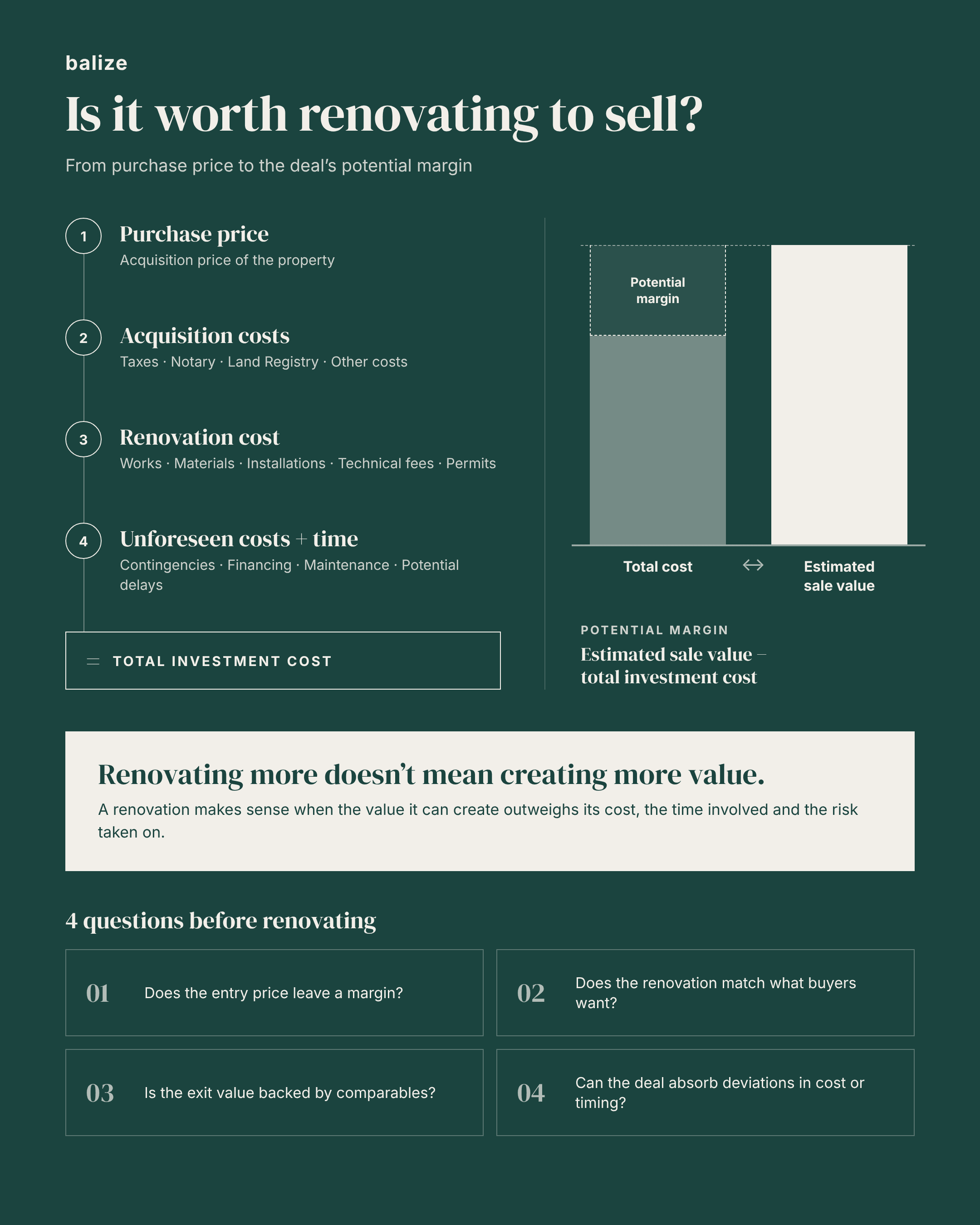
To assess the profitability of a property renovation, it is not enough to subtract the purchase price from the sale price. A real estate investment involves many other costs.
In simplified terms:
Total cost = purchase price + taxes and acquisition costs + renovation + professional fees + licences + financing + holding costs + marketing + other costs
This total cost can then be compared with the expected exit value:
Potential margin = estimated sale price − total cost of the operation
Practical example of buying, renovating and selling
Imagine a property acquired for €250,000.
The estimated total cost of the operation would therefore be €340,000.
If, after analysing comparable renovated properties, the estimated exit price is €400,000, there would initially be a €60,000 difference between the expected cost and estimated sale value.
However, that €60,000 should not automatically be interpreted as the final profit. Taxes, renovation overruns, delays, negotiations over the final sale price and other unforeseen costs would still need to be considered.
For this reason, when renovating to sell, it is important to work with different scenarios and maintain an adequate margin of safety in the real estate investment.
A real balize case study: renovating to sell in Concha Espina, Madrid
A real example of how renovating to sell can become a value-creation strategy is Concha Espina, a project developed by balize in El Viso, Madrid.
The operation involved the complete repositioning of a 197 m² exterior apartment built in 1969. The property had a layout typical of its time, with compartmentalised spaces, long corridors, a separate kitchen and finishes that required comprehensive updating.
The strategy went beyond simply improving the property's appearance. A complete renovation was designed to adapt the asset to current market demand, including:
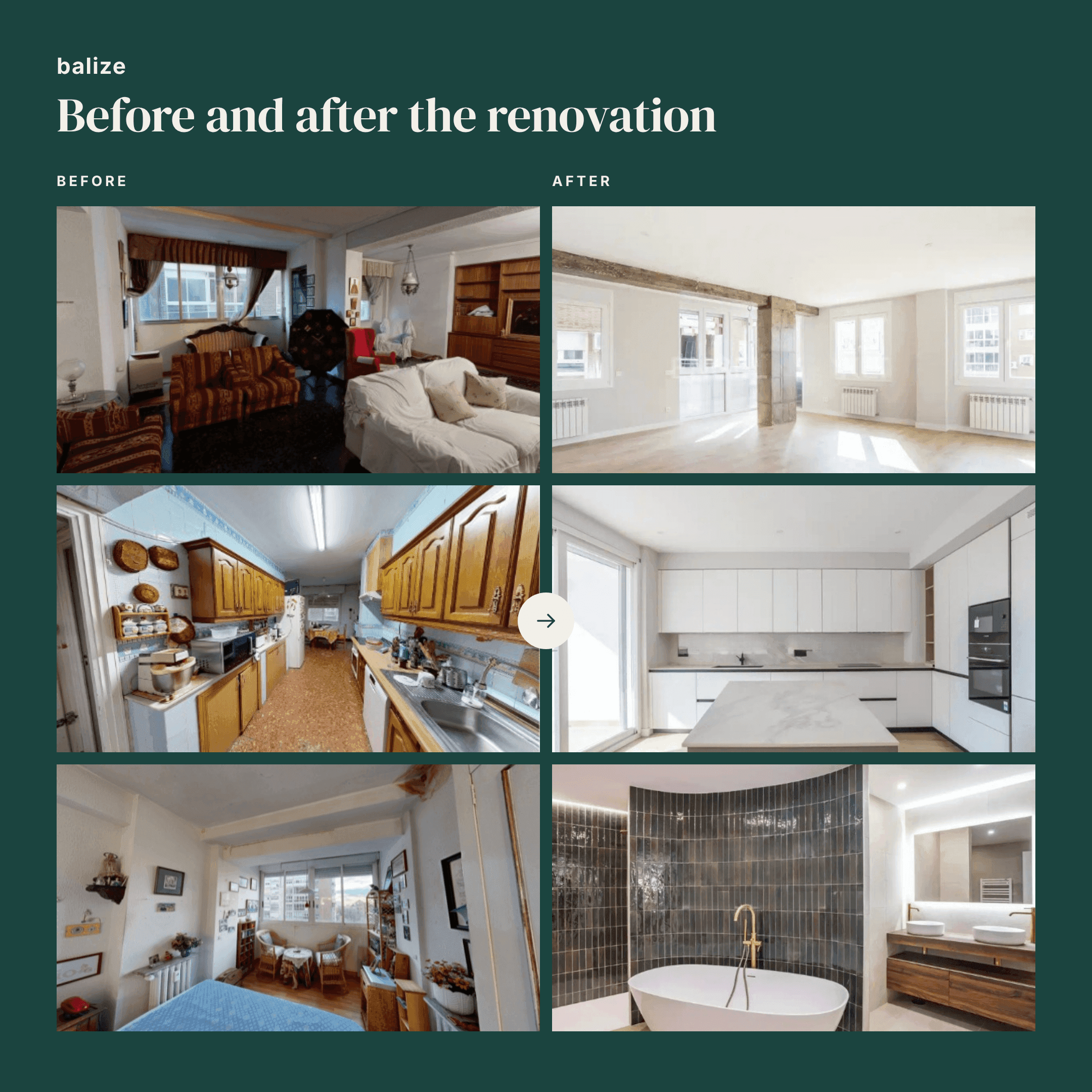
After the renovation, the property was transformed into a more modern and functional home, with a layout designed to maximise space and natural light. The finished property included a spacious kitchen integrated into the living and dining area, three double bedrooms, a principal suite with dressing room and bathroom, two full bathrooms, a guest WC and two terraces.
The operation involved a total investment of €1,128,000 and had a 10-month duration. The project achieved a total return of 22%, compared with 12% in the initial realistic scenario, and an IRR of 26.4%, compared with the initial estimate of 21%.
If you would like to explore the transformation of the asset in greater detail, you can view the full Concha Espina case study, where we show the property's starting point, the repositioning process, the result of the renovation and the key figures of the operation.
Concha Espina illustrates one of the fundamental ideas behind this guide: renovating to sell is not about spending more on a property, but about identifying the improvements that can transform its positioning and create sufficient value relative to the capital, time and risk involved.
In this case, the result was not driven by the renovation alone. The location in El Viso, the property's initial potential, the new layout, the standard of finishes, execution of the renovation and subsequent sales strategy all formed part of the same investment strategy.
Renovation budget: much more than the cost of the works
One of the common mistakes when analysing a buy, renovate and sell operation is to consider only the contractor's quotation.
The overall budget may include, among other items:
There is also another less obvious cost: time. If a renovation takes longer than expected, financing costs, utilities, community fees, insurance and other costs associated with holding the asset until its sale may also increase.
How much should you allow for renovation contingencies?
Renovation works can uncover issues that were not fully visible during the initial assessment, such as deteriorated installations, damp, building elements in worse condition than expected or additional works required to complete certain parts of the project.
For this reason, an investment budget should include a contingency allowance appropriate to the property's age, condition, scope of renovation and the amount of information available before work begins.
There is no single percentage that is appropriate for every project. A relatively modern property requiring mainly cosmetic improvements presents a different level of uncertainty from an older property undergoing a complete renovation.
The contingency should not be viewed as money that will necessarily be spent, but as protection against deviations that could reduce the operation's margin.
Time also affects the profitability of renovating to sell
The profitability of renovating to sell depends both on the financial result and on the time required to achieve it.
An operation may go through several stages:
Purchase → design and licences → renovation → completion → marketing → sale
Any delay at one of these stages can extend the investment horizon and increase certain costs.
For this reason, two operations generating the same nominal profit can produce very different investment results if one takes only a few months to complete while the other requires a significantly longer period.
Renovating to sell: 7 mistakes that can reduce profitability
1. Paying too much for the property
A good renovation is unlikely to compensate for an acquisition price that leaves too little margin from the outset. Value creation begins with the purchase.
2. Over-renovating the property
Installing finishes or features significantly above the standard demanded by the local market can increase the budget without generating an equivalent increase in the sale price.
3. Renovating according to personal taste
The objective of renovating a property to sell is not to create the investor's ideal home, but to produce a property that is aligned with the preferences of the target buyer.
4. Underestimating costs
Considering only the renovation budget can result in the expected return being very different from the return ultimately achieved.
5. Failing to account for deviations
Assuming there will be no unforeseen issues, delays or changes during execution increases the risk of the operation.
6. Using an overly optimistic sale price
The exit value should be supported by comparable properties and different scenarios, rather than simply using the highest asking price in the area.
7. Failing to define the exit strategy before buying
Before acquiring the asset, investors should understand who the target buyer is, what type of property that segment demands and what alternatives are available if the sales process takes longer than expected.
Checklist before buying a property to renovate and sell
Before pursuing a renovate-to-sell strategy, investors can consider the following questions:
The more answers depend on highly optimistic scenarios, the more sensitive the investment will be to deviations from the original business plan.
Renovating to sell as a real estate investment strategy
Renovating to sell is a value-creation strategy: rather than relying solely on a general increase in property prices, the investor seeks to transform the asset to improve its positioning and increase its potential value.
This approach is closely related to certain Value-Add real estate investment strategies, where part of the potential return is generated by actively improving an asset.
However, the renovation is only one part of the operation. The final result also depends on the acquisition price, location, total cost, execution, timeline and exit strategy.
For this reason, before investing it is important to conduct a comprehensive analysis of the risks involved in real estate investment and assess how the operation would perform under scenarios that differ from the original assumptions.
Frequently asked questions about renovating to sell
Is buying, renovating and selling a property profitable?
It can be when there is a sufficient difference between the total investment cost and the property's reasonable sale value after renovation. Profitability will depend on factors including the acquisition price, renovation costs, associated expenses, timeline, final sale price and taxation.
Which renovations add the most value to a property?
It depends on the property's initial condition and target market. Improving the layout, renovating kitchens and bathrooms, updating installations, improving energy efficiency and modernising finishes can all help increase a property's value when they respond to genuine buyer demand.
Is a complete or partial renovation better when selling?
There is no single answer. A complete property renovation may make sense when the asset is significantly outdated or requires comprehensive repositioning. In other cases, a partial or light renovation may offer a better relationship between the capital invested and the value created.
How can you tell whether a property is worth renovating before selling?
The total cost of the operation should be estimated and compared with a reasonable exit price based on comparable properties. The timeline, execution risks and different cost and sale scenarios should also be considered.
How much can a property increase in value after renovation?
There is no universal percentage. The increase in value depends on the location, initial condition, property characteristics, quality and suitability of the renovation, comparable supply and market demand at the time of sale.
Which costs should be considered when renovating to sell?
In addition to the purchase price and renovation works, costs may include taxes, acquisition expenses, professional fees, licences, financing, community fees, utilities, insurance, marketing, contingencies and expenses associated with the sale.
When renovating to sell, is it more important to spend more or to choose the right improvements?
The objective should not be to maximise the renovation budget, but to identify the improvements that can sufficiently enhance the property's value and marketability. Additional investment only makes sense when there is a reasonable expectation that it will create more value than it costs.
Conclusion: renovating more does not necessarily mean creating more value
Renovating to sell can transform a property and create an investment opportunity, but the objective should not be to carry out the most extensive renovation possible. The objective is to identify the improvements capable of creating more value than they cost.
A sound strategy begins with an appropriate entry price, continues with a renovation tailored to the asset and its target buyer, and ends with an exit strategy based on reasonable assumptions.
The Concha Espina case demonstrates how an acquisition, repositioning and sale strategy can create value when there is alignment between the asset, location, renovation, execution and exit strategy. However, the results achieved in a specific operation do not guarantee equivalent results in future investments.
At balize, we analyse real estate opportunities by considering not only an asset's transformation potential, but also its acquisition price, the costs required to execute the strategy, the risks involved, the investment horizon, the margin of safety and the available exit alternatives.
If you would like to explore our available opportunities, you can request access to balize's private investors club.
This content is provided for informational and educational purposes only and does not constitute financial, tax or investment advice. The returns stated for the Concha Espina case study represent the historical results of a specific investment. Past performance does not guarantee future results. All investments involve risk, and the results of a real estate investment may differ from initial estimates.