


Real Estate REO refers to a property that has become owned by a financial institution or creditor following a recovery or foreclosure process. REO stands for Real Estate Owned, and these properties form part of the broader distressed real estate investment landscape.
For investors, the appeal of an REO asset does not simply lie in the fact that it has been foreclosed or repossessed. An opportunity may arise when there is an attractive combination of entry price, underlying property value, costs required to bring the asset to market and potential exit value.
Investing in REO therefore requires analysing the property as a complete real estate investment. Buying at a discount can be important, but so are the possession status, condition of the property, required improvements, local demand and the time needed to execute the strategy.
What does REO mean in real estate?
REO stands for Real Estate Owned and refers to a property that has become owned by a financial institution or creditor following a process related to an outstanding debt.
A residential property, commercial unit, building or other real estate asset may have been used as collateral for financing. If the borrower defaults and the recovery process ultimately results in the property being repossessed or foreclosed, the creditor may become the owner of the asset. At this point, the property can be considered an REO.
From an investment perspective, this transition is important because the focus of the transaction shifts from recovering the debt to managing the underlying real estate asset itself.
An investor can therefore assess the opportunity using fundamentally real estate-related variables: acquisition cost, current market value, required improvements, expected management period and the price at which the property could ultimately be sold.
Why can foreclosed properties create investment opportunities?
A foreclosed property can represent an investment opportunity when its price and circumstances provide sufficient margin between the total cost of the investment and a realistic exit value.
This does not mean that all REO properties are inexpensive or that every foreclosed asset automatically represents an attractive investment.
The origin of the asset may mean that its current owner has different objectives from those of a typical private property owner. For example, there may be an incentive to reduce real estate exposure, recover liquidity or dispose of certain assets.
However, investors should assess each opportunity on its own fundamentals.
An apparently attractive discount can quickly become less compelling if the investment subsequently involves:
Therefore, a discount only becomes meaningful when assessed against the total investment cost and a realistic market value.
From default to property: how does an asset become REO?
To understand REO investing, it is useful to look at what may happen before a property reaches this stage.
In simplified terms, the process could look like this:
Financing → default → recovery or enforcement → foreclosure/repossession → REO → asset management → market exit.
During the earlier stages, the debt is the central element. However, when the recovery process results in the creditor taking ownership of the property, the focus shifts directly to the real estate asset.
This transition also explains the difference between REO and real estate NPLs: with an NPL, the investor acquires a credit position linked to a non-performing loan, whereas with an REO, the property itself has already become the asset around which the investment strategy is developed.
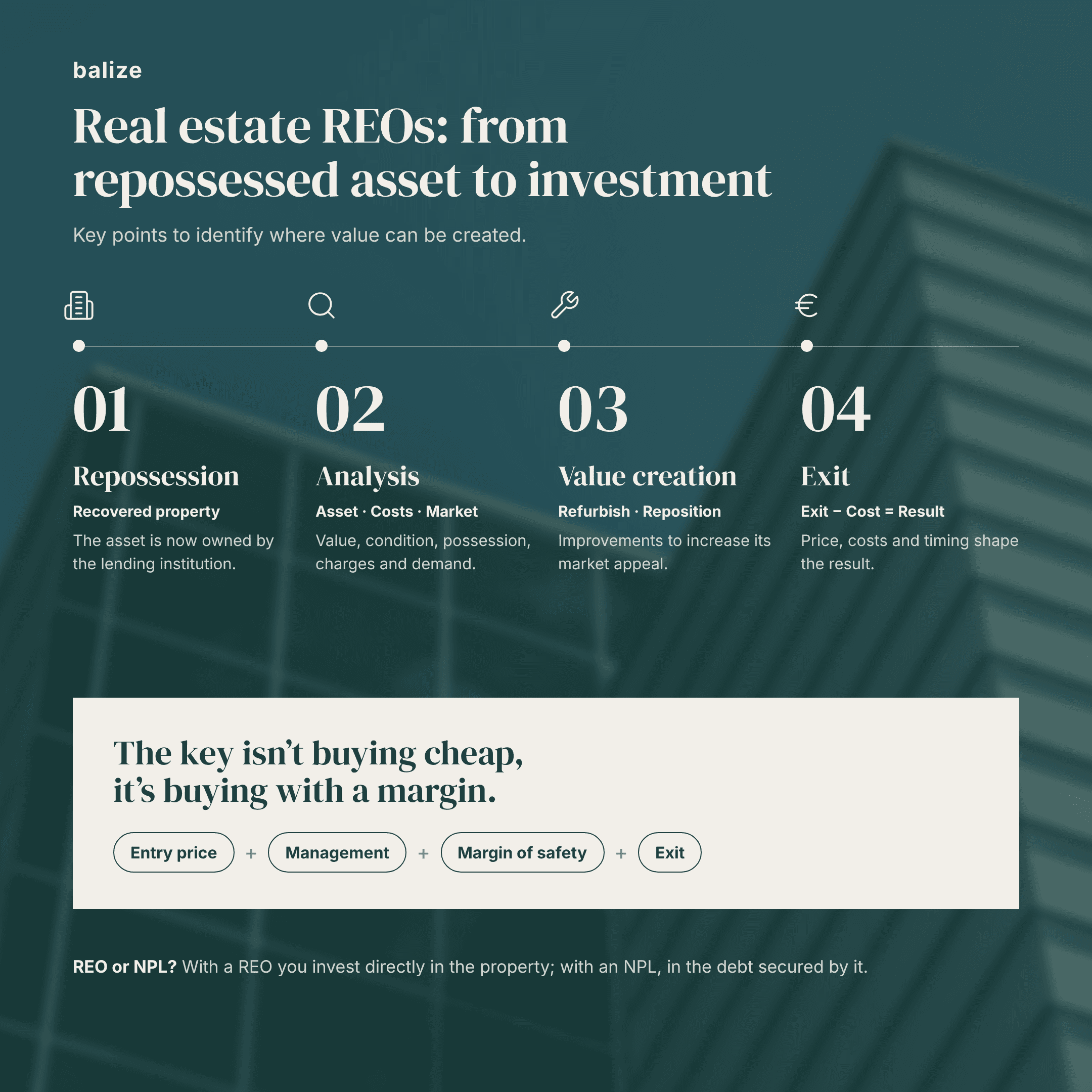
Entry price: one of the key factors in REO investing
The acquisition price can have a significant impact on the outcome of an REO investment because it determines how much margin is available to absorb additional costs, delays or changes in the final sale price.
However, looking at the purchase price alone can lead to misleading conclusions.
An investor should calculate the total entry cost, incorporating not only the price paid for the property but also the expenses required to bring the asset to the stage at which the intended strategy can be executed.
In simplified terms:
Total cost = acquisition + taxes + expenses + refurbishment + financing + maintenance + marketing.
This total cost can then be compared with different exit scenarios.
For example, a property may appear to trade at a significant discount compared with similar assets in the area. However, if substantial investment is required to bring it to a comparable condition, part of that apparent discount may disappear.
This is why the acquisition price should be assessed together with the margin of safety in real estate investment.
Where can value be created in an REO asset?
Value creation in an REO asset can come from both an efficient acquisition and the actions taken to improve the property before its exit to market.
There is no single strategy. The appropriate approach will depend on the characteristics of the property and its particular circumstances.
Refurbishment or improvements
Some properties may require improvements to their condition, functionality or presentation before being marketed.
The objective is not necessarily to carry out the most extensive refurbishment possible, but rather to determine which additional investment can create enough value to justify its cost.
Regularisation and management
Some transactions may require documentary, registry, administrative or possession-related issues to be resolved before the exit strategy can be executed.
These actions may not physically change the property, but they can significantly affect its marketability.
Repositioning
There may also be potential to adapt the asset to a different type of demand, improve its market positioning or implement a real estate strategy different from its previous use.
Where active management is used to improve the property and its positioning, the investment may share certain characteristics with value-add real estate investment strategies.
Marketing and sale
Finally, part of the value creation may depend on executing the commercial strategy effectively: setting a price consistent with the market, identifying the target buyer and selecting the appropriate timing and channels for the sale.
Buying cheaply does not always mean buying well
One of the most important mistakes when analysing REO assets is assuming that a significant discount against a reference price automatically makes a property a good investment.
A property may appear inexpensive for entirely justified reasons.
It may require substantial refurbishment, have a complex possession situation, be located in a market with limited liquidity or require a considerable period before it can be sold.
This is why it is useful to distinguish between:
The opportunity does not necessarily lie in buying the cheapest asset, but in acquiring a property at a price that makes sense relative to its value, risks and the strategy required to realise that value.
How should the exit potential of an REO be analysed?
The exit strategy should be analysed before acquiring the asset, not afterwards.
If the objective is to sell the property, it is essential to understand who the potential buyer may be, what level of demand exists and what price the market can realistically support.
Key variables to assess include:
It can also be useful to build several scenarios — for example, base, downside and upside cases — by adjusting variables such as the sale price, costs and investment period.
In our guide on how to financially analyse a real estate investment opportunity, we explain some of the variables that can be used to assess these scenarios.
What can reduce the return on an REO investment?
The outcome of an REO investment can be affected by multiple variables between acquisition and exit.
Some of the most relevant include:
For this reason, analysing expected returns without considering risk provides an incomplete picture. In our article on real estate investment risks, we explain how different variables can affect an investment.
How is the return on an REO investment calculated?
The return on an REO investment should be calculated by taking into account all the costs required to execute the strategy as well as the length of time for which the capital remains invested.
A basic approach can start with:
Investment result = exit value − total investment cost.
However, knowing the absolute profit is not enough to compare investments.
It is also important to assess the return generated relative to the capital invested and how long it took to achieve that result.
For this reason, metrics such as net return or IRR can help compare different opportunities and scenarios with different investment horizons. In our guide on gross return, net return and real estate IRR, we explain the differences between these metrics.
REO, property auctions and assignment of the winning bid: three different stages
REO, property auctions and assignment of the winning bid are not different terms for the same transaction. They may all be related to asset recovery processes, but they refer to different situations.
A property auction may form part of the process through which an asset is realised. An assignment of the winning bid is a specific legal mechanism through which, where the relevant requirements are met, the rights arising from an award can be transferred to a third party.
An REO, by contrast, describes a later situation: the property has already become owned by the financial institution or creditor.
In our guide on what an assignment of the winning bid is and how it works, we examine this mechanism in greater detail.
What should you review before investing in a foreclosed property?
Before making an investment decision involving a real estate REO, it can be useful to structure the analysis around four areas.
1. The asset
2. The property's situation
3. The numbers
4. The exit
Analysing these four areas together can provide a clearer picture of whether a genuine opportunity exists or whether the initial discount simply compensates for the problems, costs and risks associated with the property.
The role of REO assets within distressed real estate
REO assets are one of the different ways investors can gain exposure to the distressed real estate market.
This market is not limited to foreclosed properties. It can also include NPL debt, property auctions, assignments of winning bids and other special situations involving real estate assets or financing.
A single distressed situation may evolve through several different stages:
Distressed debt → recovery → foreclosure/repossession → property management → exit.
Each stage has a different investment logic. In some transactions, value creation may depend primarily on acquiring and managing a debt position effectively; in others, it may involve acquiring the property directly and implementing a real estate strategy.
Therefore, before considering potential returns, it is essential to answer a more fundamental question: what exactly are we buying, and where does the opportunity to create value come from?
How does balize analyse these opportunities?
At balize, we analyse real estate opportunities across different strategies before presenting them to our private investment club, including transactions linked to the distressed real estate market.
When an opportunity involves a foreclosed property, the fact that it is an REO does not in itself constitute the investment thesis. The analysis should focus on the fundamentals of the transaction: entry price, underlying asset, legal and possession status, costs, value creation strategy, investment period and exit.
This approach makes it possible to assess the opportunity as a complete real estate investment and understand how much margin may exist if the outcome is less favourable than initially expected.
Frequently asked questions about real estate REO
What does REO mean?
REO stands for Real Estate Owned and refers to a property that has become owned by a financial institution or creditor following a recovery, foreclosure or repossession process.
Is an REO always owned by a bank?
Not necessarily. Although the term is frequently associated with properties recovered by banks and financial institutions, the relevant point is that the creditor has become the owner of the property as a result of the relevant process.
Is an REO the same as an NPL?
No. An NPL is a debt position experiencing payment problems and may be secured by a property. With an REO, the process has progressed to the point where the property itself has become owned by the creditor.
Are REO properties always purchased below market value?
No. Their origin does not guarantee a discount. The acquisition price should be compared with the property's realistic value and, importantly, with all the costs and risks required to execute the investment strategy.
Does an REO property always require refurbishment?
Not necessarily. Some assets may require a complete refurbishment, others only minor improvements, while some may already be ready for sale. The decision should depend on the condition of the property and whether additional investment is likely to add sufficient value to the strategy.
Where does the return on an REO investment come from?
The potential return may come from the difference between the total cost of acquiring and managing the property and the value achieved through the exit strategy, while also taking into account the time required to complete the investment.
Conclusion
Real estate REO provides a way to approach the distressed market from a fundamentally real estate-focused perspective: the property has already been foreclosed or repossessed, and the analysis therefore centres on what can be done with the asset and at what cost.
The key is not simply to find a property originating from a distressed situation, but to identify an appropriate combination of entry price, value, costs, management, investment period and exit strategy.
Before investing in foreclosed properties, it is therefore essential to analyse the entire transaction, work with conservative scenarios and determine whether there is sufficient margin to absorb potential deviations.
At balize, we analyse and select real estate opportunities before presenting them to our private investment club. If you would like to explore our available investment opportunities, you can request access to the balize private investment club.
*All investments involve risk. Investing in REO assets and other distressed real estate transactions may involve financial, real estate, legal, valuation, possession, cost, liquidity and timing risks. Acquiring an asset originating from a distressed situation does not guarantee a discount to market value or any specific return. Actual results, costs and timelines may differ from initial estimates. This content is provided for informational purposes only and does not constitute financial, tax, legal or investment advice.