


The margin of safety in real estate investment is the ability of an investment to absorb deviations in variables such as the sale price, costs or timeline without fundamentally compromising its investment thesis.
In other words, an investment with a margin of safety should not depend on every single forecast being met exactly in order to achieve a reasonable outcome. The entry price, asset value, expected costs and exit strategy are some of the variables that determine this margin.
Analysing it provides a more comprehensive view of an opportunity: rather than simply asking how much a real estate investment could generate, investors should also consider how much room there is if the final outcome is less favourable than expected.
What is the margin of safety in a real estate investment?
The margin of safety of an investment represents the buffer between the assumptions on which an investment is based and a less favourable scenario.
The concept of margin of safety originates from the investment world and is traditionally associated with acquiring an asset below its estimated value. When applied to real estate, the acquisition price remains fundamental, but the analysis can go further.
A real estate investment may also depend on:
Therefore, a greater margin of safety in real estate means that the investment has a certain capacity to withstand deviations without relying exclusively on the most favourable scenario.
Why is the entry price important?
The purchase price of a property is one of the main variables determining the margin of safety in a real estate investment.
Two investors can acquire exactly the same asset and assume different levels of risk simply because they paid different prices.
If an investment is acquired at a price very close to the value expected to be achieved upon exit, there is less room to absorb cost overruns, delays or a potential reduction in the exit price.
By contrast, an acquisition completed on attractive terms may provide a greater buffer against certain deviations.
This does not mean that buying cheaply automatically makes an opportunity a good investment. The asset, location, costs, demand and strategy must still be carefully analysed. The entry price is a fundamental part of the equation, but it is not the only one.
How do you analyse the margin of safety in a real estate investment?
A practical way to analyse the margin of safety in real estate is to assess how the outcome of an investment changes when some of its key assumptions are adjusted.
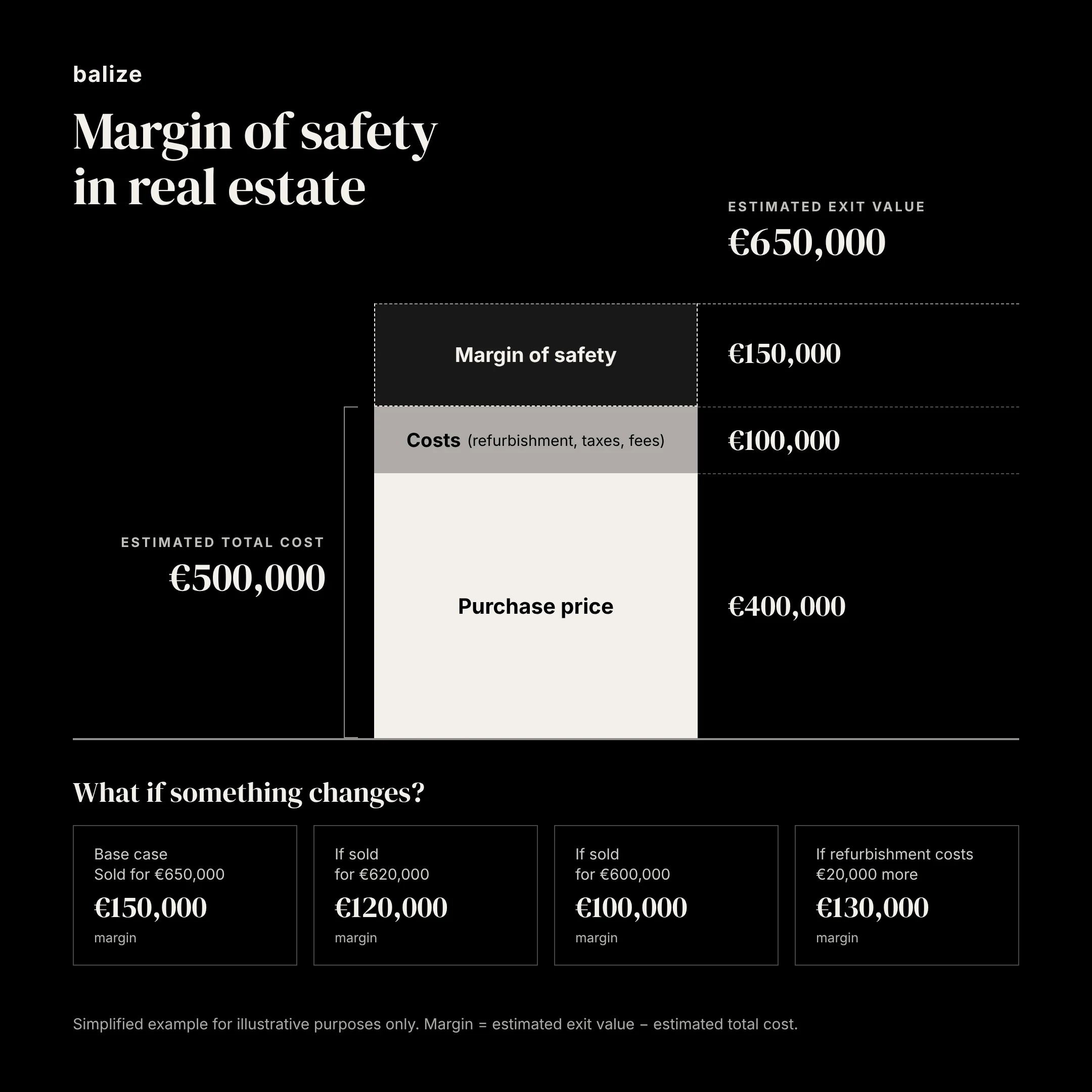
Consider a simplified investment:
In the initial scenario, there is a €150,000 difference between the estimated total cost and the expected exit value.
However, the real analysis begins when we stop assuming that everything will happen exactly as planned.
For example:
The objective is not to predict exactly which scenario will occur, but to understand how far an investment can deviate from the initial assumptions before its returns are significantly affected.
This analysis is directly related to the risks of real estate investment, as it helps assess how certain deviations could affect the expected outcome.
Margin of safety and returns: they are not the same
A high potential return does not necessarily mean that an investment has a wide margin of safety.
An investment may offer an attractive estimated IRR while simultaneously relying on demanding assumptions regarding the sale price, costs or timeline.
Likewise, two projects with similar expected returns may have very different risk profiles if one has a greater capacity to absorb deviations.
This is why it is important to analyse the following factors together:
In our article on gross return, net return and real estate IRR, we explain the main metrics used to assess the return of an investment.
How can the margin of safety in real estate be increased?
The margin of safety can be strengthened through an attractive entry price, prudent assumptions, appropriate cost control and an exit strategy based on market data.
Some practices that may contribute to this include:
It is particularly important to avoid situations where an investment only works if every assumption is met exactly. The more variables that need to perform perfectly to achieve the expected outcome, the lower the project's ability may be to absorb deviations.
Is there an ideal margin of safety percentage?
There is no universal margin of safety percentage that applies to every real estate investment.
The appropriate margin will depend on the type of asset, strategy, financing, timeline, execution complexity and the level of uncertainty surrounding the main assumptions.
For example, an investment involving a significant transformation of a property may require different contingencies from those of an already stabilised asset.
For this reason, rather than focusing on a single figure, it is useful to assess which variables could change and how much the investment could withstand if they do.
How does balize analyse the margin of safety of an opportunity?
At balize, the analysis of a real estate opportunity starts with understanding both its potential return and the variables required to achieve it.
The acquisition price, costs, asset, location, timeline, strategy and exit value all form part of the analysis carried out before projects are presented to our private investors club.
In addition to the expected scenario, analysing how certain deviations could affect the outcome provides greater perspective on the relationship between potential return, risk and margin of safety.
This analysis forms part of a broader opportunity selection process. In our guide on how to financially evaluate a real estate investment opportunity, we explain other variables that should be considered before investing.
Frequently asked questions about the margin of safety in real estate
What is the margin of safety in real estate investment?
The margin of safety in real estate investment reflects an investment's ability to absorb certain deviations in price, costs, timeline or exit value without fundamentally compromising its investment thesis.
How is the margin of safety in real estate calculated?
There is no single formula that applies to every real estate project. It can be analysed by comparing the total cost with a prudent valuation of the asset and, in particular, by assessing how the outcome changes under less favourable scenarios.
Does a greater margin of safety eliminate risk?
No. The margin of safety does not eliminate risk or guarantee investment returns. Its purpose is to provide greater capacity to absorb certain deviations from the initial assumptions.
Why is the purchase price so important?
Because it determines part of the available margin from the outset. An attractive entry price may provide greater capacity to absorb cost overruns or variations in the exit price, although it should always be analysed alongside the other variables of the investment.
Conclusion
The margin of safety in real estate investment allows investors to assess an opportunity beyond its expected return and consider what might happen if certain assumptions are not met exactly.
Entry price, costs, timelines and exit value are closely interconnected. An investment with some capacity to absorb deviations starts from a different position from one whose outcome depends on every forecast being met precisely.
Before investing, it is therefore important to consider not only how much an investment could generate, but also how much room exists between the expected scenario and more conservative outcomes.
At balize, we analyse and select real estate opportunities before presenting them to our private investors club. If you would like to explore the projects currently available, you can request access to balize's private investors club.
*All real estate investments involve risk. The margin of safety, scenario analysis, selection and professional management may help identify and manage certain risks, but they do not guarantee returns or prevent potential losses. Valuations, costs, timelines and actual results may differ from initial estimates. This content is provided for informational purposes only and does not constitute financial, tax, legal or investment advice.